Showing posts with label healthcare IT risk. Show all posts

Tuesday, January 15, 2013

New York Times: "In Second Look, Few Savings From Digital Health Records", and AMA Med News on EHR Harms

This post should perhaps be entitled "I told you so."

A letter I wrote in response to the Wall Street Journal's "A Health-Tech Monopoly", Feb. 11, 2009 was published Feb. 18, 2009 under the header Digitizing Medical Records May Help, but It's Complex.

I wrote:

Dear Wall Street Journal,

You observe that the true political goal is socialized medicine facilitated by health care information technology. You note that the public is being deceived, as the rules behind this takeover were stealthily inserted in the stimulus bill.

I have a different view on who is deceiving whom. In fact, it is the government that has been deceived by the HIT industry and its pundits. Stated directly, the administration is deluded about the true difficulty of making large-scale health IT work. The beneficiaries will largely be the IT industry and IT management consultants.

For £12.7 billion the U.K., which already has socialized medicine, still does not have a working national HIT system, but instead has a major IT quagmire, some of it caused by U.S. HIT vendors.

HIT (with a few exceptions) is largely a disaster. I'm far more concerned about a mega-expensive IT misadventure than an IT-empowered takeover of medicine.

The stimulus bill, to its credit, recognizes the need for research on improving HIT. However this is a tool to facilitate clinical care, not a cybernetic miracle to revolutionize medicine. The government has bought the IT magic bullet exuberance hook, line and sinker.

I can only hope patients get something worthwhile for the $20 billion.

Scot Silverstein, M.D.
Faculty, Biomedical Informatics
Drexel University Institute for Healthcare Informatics
Philadelphia

I also had penned essays on the need for a moratorium on HITECH (Nov. 2008, "Should The U.S. Call A Moratorium On Ambitious National Electronic Health Records Plans?" and Jan. 2009, "I Ask Again: Should The U.S. Call A Moratorium On Ambitious National Electronic Health Records Plans?").  My theme was that the issues with implementation of good health IT and elimination of bad health IT, and the issue of how to implement most efficiently, needed to be better understood before a national rollout.  Hold off multi-billion dollar national initiatives "until we know how to get HIT right", I wrote.

Now the New York Times has this, citing a new RAND paper:

In Second Look, Few Savings From Digital Health Records
By REED ABELSON and JULIE CRESWELL

January 10, 2013

The conversion to electronic health records has failed so far to produce the hoped-for savings in health care costs and has had mixed results, at best, in improving efficiency and patient care, according to a new analysis by the influential RAND Corporation.

Optimistic predictions by RAND in 2005 helped drive explosive growth in the electronic records industry and encouraged the federal government to give billions of dollars in financial incentives to hospitals and doctors that put the systems in place.

“We’ve not achieved the productivity and quality benefits that are unquestionably ["unquestionably?" why?- ed.]  there for the taking,” said Dr. Arthur L. Kellermann, one of the authors of a reassessment by RAND that was published in this month’s edition of Health Affairs, an academic journal.

Noted is the provenance of the 2005 report that created the windfall for the electronic records industry:

RAND’s 2005 report was paid for by a group of companies, including General Electric and Cerner Corporation, that have profited by developing and selling electronic records systems to hospitals and physician practices. Cerner’s revenue has nearly tripled since the report was released, to a projected $3 billion in 2013, from $1 billion in 2005.

A retraction:

The report predicted that widespread use of electronic records could save the United States health care system at least $81 billion a year, a figure RAND now says was overstated. The study was widely praised within the technology industry and helped persuade Congress and the Obama administration to authorize billions of dollars in federal stimulus money in 2009 to help hospitals and doctors pay for the installation of electronic records systems ... But evidence of significant savings is scant, and there is increasing concern that electronic records have actually added to costs by making it easier to bill more for some services.

In my Feb. 2009 WSJ letter, I'd written that "it is the government that has been deceived by the HIT industry and its pundits. Stated directly, the administration is deluded about the true difficulty of making large-scale health IT work. The beneficiaries will largely be the IT industry and IT management consultants."  It appears I was correct.

Officials at RAND said their new analysis did not try to put a dollar figure on how much electronic record-keeping had helped or hurt efforts to reduce costs. But the firm’s acknowledgment that its earlier analysis was overly optimistic adds to a chorus of concern about the cost of the new systems and the haste with which they have been adopted.

Not mentioned are harms that bad health IT is creating.

The recent analysis was sharply critical of the commercial systems now in place, many of which are hard to use and do not allow doctors and patients to share medical information across systems. “We could be getting much more if we could take the time to do a little more planning and to set more standards,” said Marc Probst, chief information officer for Intermountain Healthcare, a large health system in Salt Lake City that developed its own electronic records system

A "little more" planning?  How about several years' worth, to ensure the technologies are safe, effective and properly vetted, along with a system for post-market surveillance as exists in other healthcare sectors?

Technology “is only a tool,” said Dr. David Blumenthal, who helped oversee the federal push for the adoption of electronic records under President Obama and is now president of the Commonwealth Fund, a nonprofit health group. “Like any tool, it can be used well or poorly.” While there is strong evidence that electronic records can contribute to better care and more efficiency, Dr. Blumenthal said, the systems in place do not always work in ways that help achieve those benefits.

Dr. Blumenthal seems to be triangulating from his earlier 2010 NEJM statement that:

... The widespread use of electronic health records (EHRs) in the United States is inevitable. EHRs will improve caregivers’ decisions and patients’ outcomes. Once patients experience the benefits of this technology, they will demand nothing less from their providers. Hundreds of thousands of physicians have already seen these benefits in their clinical practice.

Meantime, in the real world signs of my expressed concerns about a quagmire are appearing:

... Late last year, a physician practice in Panama City, Fla., filed a lawsuit against the health care technology firm Allscripts after the company stopped supporting an electronic records system called MyWay that it had sold to 5,000 small-group physicians at a cost of $40,000 per physician. The lawsuit said that the system had problems and that the physician group was unable to meet the criteria for federal incentive money. A spokeswoman for Allscripts said it would defend itself vigorously.

A clue as to the candidness of the new report:

... The new analysis was not sponsored by any corporations, said Dr. Kellermann, who added that some members of RAND’s health advisory board wanted to revisit the earlier analysis.

Finally, this from the horse's mouth:

Dr. David J. Brailer, who was the nation’s first health information czar under President George W. Bush, said he still believed tens of billions of dollars could eventually be squeezed out of the health care system through the use of electronic records. In his view, the “colossal strategic error” that occurred was a result of the Obama administration’s incentive program.

I repeat my admonition from 2009 that I can only hope patients get something worthwhile for the $20 billion, which by now is probably many times that amount.

Finally, I note the American Medical News cites me in a Jan. 14, 2013 article as follows:

... Other experts on health IT said the Pennsylvania [PA Patient Safety Authority] study probably underestimates the extent of health IT safety problems. They say that is because the research is based on voluntary reports and that health professionals are unaware that a patient safety incident was caused by an EHR failure.

“These systems are incredibly complex,” said Scot M. Silverstein, MD, a consultant in medical informatics at Drexel University in Philadelphia. “They’re not just huge filing cabinets, they are enterprise resource management systems. There are many ways that things can go wrong that may not be seen as the computer having caused the mess-up in the first place.”

For example, he said, it would be difficult for a practicing physician to detect when data are missing from a record or that an alert failed to pop up.

Yet the title of the article is "EHR-related errors soar, but few harm patients" with a table at the bottom labeled "How rarely EHR problems harm patients." More evidence that EHRs always receive special accommodation. 

I was an invited reviewer of the PA Patient Safety Authority report, and wrote about the major deficiencies of its dataset at my posts Dec. 13, 2012 post "Pennsylvania Patient Safety Authority: The Role of the Electronic Health Record in Patient Safety Events" and a follow-up Dec. 19 post "A Significant Additional Observation on the PA Patient Safety Authority Report -- Risk."

My major point was that one simply cannot know what one cannot know, when using a very incomplete dataset gathered in a setting of systematic impediments to accuracy and completeness.  For instance, as I wrote in those earlier posts, through my work I personally know of cases of harms up to and including death that should have been in the PA database, but apparently are not - and I'm just one person.

We simply don't know in 2013 how many EHR errors harm patients, and the effects of increasing adoption by organizations and physicians less technology-able than current adopters.  I hope the magnitude of harms is truly small, but hope is not enough; this study and report was just a 'dipping of the toes into the water' towards understanding the realities.

Incidentally, we also don't know how severely the known toxic effects of bad health IT might affect care in times of duress, e.g., an epidemic.  However, I am certainly not sanguine about EHRs in their present state as robustly facilitating national emergency preparedness.

My dreaded prediction for the future?  A 2016 AMA News story entitled "Known EHR-related harms soar."

-- SS

Wednesday, December 19, 2012

A Significant Additional Observation on the PA Patient Safety Authority Report "The Role of the Electronic Health Record in Patient Safety Events" -- Risk

At a Dec. 13, 2012 post "Pennsylvania Patient Safety Authority: The Role of the Electronic Health Record in Patient Safety Events" I alluded to risk in a comment in red italics:

... Reported events were categorized by their reporter-selected harm score (see Table 1). Of the 3,099 EHR-related events, 2,763 (89%) were reported as “event, no harm” (e.g., an error did occur but there was no adverse outcome for the patient) [a risk best avoided to start with, because luck runs out eventually - ed.], and 320 (10%) were reported as “unsafe conditions,” which did not result in a harmful event. 

The focus of the report is on how the "events" did not cause harm.  Thus the relatively mild caveat:

"Although the vast majority of EHR-related reports did not document actual harm to the patient, analysts believe that further study of EHR-related near misses and close calls is warranted as a proactive measure."

It occurs that if the title of the paper had been "The Role of the Electronic Health Record in Patient Safety Risk", the results might have been interpreted far differently:

In essence, from from June 2, 2004, through May 18, 2012 (the timeframe of the Pennsylvania Patient Safety Reporting System or PA-PSRS database), from a dataset highly limited in its comprehensiveness as written in the earlier post, there were approximately 3,000 "events" where an error did occur that potentially put patients at risk.

That view - risk - was not the focus of the study.  Should it have been?

These "events" really should be called "risk events."

It is likely the tally of risk events, if the database were more comprehensive (due to better recognition of HIT-related problems, better reporting, etc.) would be much higher.  So would the reports of "harm and death" events as well.

That patient harm did not occur from the majority of "risk events" was through human intervention, which is to say, luck, in large part

Luck runs out, eventually.

I have personally saved a relative several times from computer-related "risk events" that could have caused harm if I were not there personally, and with my own medical knowledge, to have intervened.  My presence was happenstance in several instances; in fact a traffic jam or phone call could have caused me to have not been present.

What's worse, the report notes:

Analysts noted that EHR-related reports are increasing over time, which was to be expected as adoption of EHRs is growing in the United States overall.

In other words, with the current national frenzy to implement healthcare information technology, these "risk events" - and "harm and death events" - counts will increase.  My concern is that they will increase significantly.

I note that health IT is likely the only mission-critical technology that receives special accommodation regarding risk events.  "If the events didn't cause harm, then they're not that important an issue" seems to be the national attitude overall.

Imagine aircraft whose avionics and controls periodically malfunction, freeze, provide wrong results, etc., but most are caught by hyper-vigilant pilots so planes don't go careening out of control and crash.  Imagine nuclear plants where the same occurs, but due to hypervigilance the operators prevent a nuclear meltdown.

Then, imagine reports of these "risk events" - based on fragmentary reporting of pilots and nuclear plant operators reluctant to do so for fear of job retaliation - where the fact of their occurrence takes a back seat to the issue that the planes did not crash, or Three Mile Island or Chernobyl did not reoccur.

That, in fact, seems to be the culture of health IT.

I submit that the major focus that needs addressing in health IT is risk - not just confirmed body counts.

-- SS

Sunday, September 30, 2012

UK: Another Example of IT Malpractice With Bad Health IT (BHIT) Affecting Thousands of Patients, But, As Always, Patient Care Was "Not Compromised"

At my Dec. 2011 post "IT Malpractice? Yet Another "Glitch" Affecting Thousands of Patients. Of Course, As Always, Patient Care Was "Not Compromised" and others, I noted:

... claims [in stories regarding health IT failure] that "no patients were harmed" ... are both misleading and irrelevant:

Such claims of 'massive EHR outage benevolence' are misleading, in that medical errors due to electronic outages might not appear for days or weeks after the outage ... Claims of 'massive EHR outage benevolence' are also irrelevant in that, even if there was no catastrophe directly coincident with the outage, their was greatly elevated risk. Sooner or later, such outages will maim and kill.

Here is a prime example of why I've opined at my Sept. 2012 post "Good Health IT (GHIT) v. Bad Health IT (BHIT): Paper is Better Than The Latter" that a good or even average paper-based medical record keeping system can facilitate safer and better provision of care than a system based on bad health IT (BHIT).

Try this with paper:

NHS 'cover-up' over lost cancer patient records

Thousands awaiting treatment were kept in the dark for five months when data disappeared

Sanchez Manning
The Independent
Sunday 30 September 2012

Britain's largest NHS trust took five months to tell patients it had mislaid medical records for thousands of people waiting for cancer tests and other urgent treatments. Imperial College Healthcare NHS Trust discovered in January that a serious computer problem and staff mistakes had played havoc with patient waiting lists.

It's quite likely the "serious computer problem" far outweighed the impact of "staff mistakes", as disappearing computer data does so in a "silent" manner.  One does not realize it's missing as there's not generally a trail of evidence that it's gone.

About 2,500 patients were forced to wait longer on the waiting lists than the NHS's targets, and the trust had no idea whether another 3,000 suspected cancer patients on the waiting list had been given potentially life-saving tests. Despite the fact that the trust discovered discrepancies in January and was forced to launch an internal review into the mess, including 74 cases where patients died, it did not tell GPs about the lost records until May.

That is, quite frankly, outrageous if true and (at least in the U.S.) might be considered criminally negligent (failure to use reasonable care to avoid consequences that threaten or harm the safety of the public and that are the foreseeable outcome of acting in a particular manner).

Revelations about the delay prompted a furious response yesterday from GPs, local authorities and patients' groups. Dr Tony Grewal, one of the GPs who had made referrals to Imperial, said doctors should have been told sooner to allow them to trace patients whose records were missing. "The trust should have contacted us as soon as it was recognised that patients with potentially serious illnesses had been failed by a system," he said. "GPs hold the ultimate responsibility for their patient care."

That is axiomatic.

The chief executive of the Patients Association, Katherine Murphy, added: "This is unacceptable for any patient who has had any investigation, but especially patients awaiting cancer results, where every day counts. The trust has a duty to contact GPs who referred the patients. It's unfair on the patients to have this stress and worry, and the trust should not have tried to hide the fact that they had lost these records. They should have let the GPs know at the outset."

Unfair to the patients is an understatement,  However, if one's attitude is that computers have more rights than patients, as many on the health IT sector seem to with their ignoring of patient rights such as informed consent, lack of safety regulation, and lack of accountability, then it's quite acceptable.

The trust defended the delay in alerting GPs, arguing that it needed to check accurately how much data it had lost before making the matter public. It said a clinical review had now concluded that no one died as a result of patients waiting longer for tests or care.

That would be perhaps OK if the subjects whose "data had been lost" through IT malpractice were lab rats.

Despite this, three London councils – Westminster, Kensington and Chelsea, and Hammersmith and Fulham – are deeply critical of the way the trust handled the data loss. Sarah Richardson, a Westminster councillor who heads the council's health scrutiny committee, said that trust bosses had attempted to "cover up" the extent of the debacle. "Yes, they've done what they can but, in doing so, [they] put the reputation of the trust first," she said. "Rather than share it with the GPs, patients and us, they thought how can we manage this information internally. They chose to consider their reputation over patient care."

As at my Oct. 2011 post "Cybernetik Über Alles: Computers Have More Rights Than Patients?", to be more specific, they may have put the reputation of the Trust's computers first. 

Last week, it was revealed that Imperial has been fined £1m by NHS North West London for the failures that led to patient data going missing. On Wednesday, an external review into the lost records said a "serious management failure" was to blame for the blunder.

Management of what, one might ask?

Imperial's chief financial officer, Bill Shields, admitted at a meeting with the councils that the letter could have been produced more quickly. He said that, at the time, the trust had operated with "antiquated computer systems" and had a "light-touch regime" on elective waiting times.

Version 2.0A will, as again is a typical refrain, fix all the problems.

Terry Hanafin, the leading management consultant who wrote the report, said the data problems went back to 2008 and had built up over almost four years until mid-2011. Mr Hanafin said the priorities of senior managers at that time were the casualty department and finance.

Clinical computing is not business computing, I state for the thousandth time.  When medical data is discovered "lost", the only response should be ... find it, or inform patients and clinicians - immediately.

He further concluded that while the delays in care turned out to be non-life threatening, they had the potential to cause pain, distress and, in the case of cancer patients, "more serious consequences" ... The trust said it had found no evidence of clinical harm and stressed that new systems have now been implemented to record patient data. It denied trying to cover up its mistakes or put its reputation before concerns for patients. "Patient safety is always our top priority," said a spokesman.

"More serious consequences" is a euphemism for horrible metastatic cancer and death, I might add.  The leaders simply cannot claim they "found no evidence of clinical harm" regarding delays in cancer diagnosis and treatment until time has passed, and followup studies performed on this group of patients.

This refrain is evidence these folks are either lying, CYA-style, or have no understanding of clinical medicine whatsoever - in which case their responsibilities over the clinic need to be ended in my opinion.

I, for one, would like to know the exact nature of the "computer problem", who was responsible, and if it was a software bug, how such software was validated and how it got into production.

-- SS

Oct. 1, 2012 Addendum:

What was behind the problems, according to another source?   

Bad Health IT (BHIT):

Poor IT behind Imperial cancer problems
e-Health Insider
28 September 2012
Rebecca Todd

An independent review of data quality issues affecting cancer patient referrals to Imperial College Healthcare NHS Trust has identified “poor computer systems” as a key cause of the problem.

The review’s report highlights the trust’s use of up to 17 different IT systems as causing problems for patient tracking.

However, it says the trust should be aware of the risks of [replacing the BHIT and] moving to a single system, Cerner Millennium, because of reported problems in providing performance data after similar moves at other London trusts.

In January 2012, the report says the NHS Intensive Support Team was reviewing the way reports on cancer waiting times were created from Imperial’s cancer IT system, Excelicare.

The team discovered that almost 3,000 patients were still on open pathways who should have been seen within two weeks. In May, letters were sent to GPs to try and ascertain the clinical status of around 1,000 patients.

BHIT must be forbidden from real-world deployments, and fixed rapidly or dismantled (as Imperial College Healthcare NHS Trust appears to be doing), although the "solution" might be just as bad, or worse, than the disease.

-- SS

Thursday, September 20, 2012

In addition to nurses, doctors now air their alarm: Contra Costa County health doctors air complaints about county's new $45 million computer system

At my Aug. 2012 post "Contra Costa's $45 million computer health care system endangering lives, nurses say", I described how an experimental EHR being forced on clinicians in Contra Costa county, California, was endangering patients who had not consented to its use, and how nurses were reported to be raising hell about it.  I also noted:

... The[se] scenarios [of EHR-created mayhem] are also usually accompanied by amoral misdirection from these personnel away from patient risks...

Herein is the problem:  the attitude that a clinic full of non-consenting patients is an appropriate testbed for alpha and beta clinical software that puts them at risk is medically unethical, based on the guidelines developed from medical abuses of the past.  There is nothing to argue or debate about this. 

Now the affected physicians have their say.

These physicians are apparently represented by a union; therefore they likely fear retaliation less than non-union physicians, and thus can be candid:

Contra Costa County health doctors air complaints about county's new $45 million computer system
By Matthias Gafni
Contra Costa Times
Posted:   09/18/2012, Updated:  09/19/2012

MARTINEZ -- One of every 10 emergency room patients at the county's public hospitals in September left without ever being seen by a doctor or nurse because of long waits -- a number rising since implementation of Contra Costa's $45 million computer system July 1.

One patient waited 40 hours to get a bed.

Dr. Brenda Reilly delivered the troubling news Tuesday afternoon to county supervisors. She was one of three dozen doctors in the supervisors' chamber complaining about EPIC, new computer software aimed at integrating all of the county's health departments to create a federally mandated electronic medical record for patients.

The response, as seen later, were characterized by the typical amoral excuses, mistaken beliefs in technological determinism, (a/k/a quasi-religious computer fanaticism) and misdirection I described above.

To allow for the major computer program installation and conversion, administrators cut doctors' patient loads in half, in turn cutting the number of available appointments in half.

In a letter to the supervisors, Dr. Ori Tzvieli -- medical staff president whose union has been negotiating a new contract with the county -- along with 14 doctor co-signers pleaded for administrators to continue scaling back physician workloads because doctors are over-stressed. Six doctors have left this year, said Dr. Keith White, a 22-year pediatrician.

I point out that such stress from interacting woth a mission hostile EHR (really, a clinician workflow-control system), and the needed state of hypervigilance to avoid IT-related mistakes that harm patients, lead to burnout and ultimately, a lower quality of patient care. 

Patient workloads were reduced by 50%, which is bad enough (and indicative of gross project mismanagement, as I wrote about in another example in my Sept. 2012 post "Lake County (IL) Health Department: The extremes to which faith-based informatics beliefs can drive healthcare facilities - Depression era soup lines at the clinic?").

Yet the 50% reduction, according to the principal end users, was still not enough.  Usability and fitness of the software is surely in question.

"We were not ready for EPIC and EPIC was not ready for us," White told supervisors. "As a result, the providers are struggling to provide safe and effective care for 100,000 citizens of the county, many of whom are very ill. We often feel that we are failing. We are very tired ... many doctors have left and all are considering leaving."

It is impossible for people, especially medical professionals, to be "ready" for a system that "is not ready for them", i.e., "bad IT" as defined at my teaching site intro at this link:

Good Health IT ("GHIT") is defined as IT that provides a good user experience, enhances cognitive function, puts essential information as effortlessly as possible into the physician’s hands, keeps eHealth information secure, protects patient privacy and facilitates better practice of medicine and better outcomes.
   
Bad Health IT ("BHIT") is defined as IT that is ill-suited to purpose, hard to use, unreliable, loses data or provides incorrect data, causes cognitive overload, slows rather than facilitates users, lacks appropriate alerts, creates the need for hypervigilance (i.e., towards avoiding IT-related mishaps) that increases stress, is lacking in security, compromises patient privacy or otherwise demonstrates suboptimal design and/or implementation.

The two phrases "We were not ready for EPIC" and "EPIC was not ready for us" do not belong together in the same sentence.

A claim that physicians (and nurses) are "struggling" to provide safe let alone effective care for 100,000 should RAISE ALARM BELLS, not produce a paternalistic, patronizing response from medical and governmental officials as it did, seen below.

Both doctors and administrators agreed Tuesday that creating an integrated electronic health record is important, but a series of white coats stepped to the podium in what they jokingly termed "Doccupy" to share their nightmarish last few months.

I disagree with the assessment that "creating an integrated electronic health record is important", in that the technology and know-how to do so without endangering the very patients the technology is supposed to protect does not yet seem to exist in the commercial sector.

In that sense, regulating EHR technology and subjecting it to controlled clinical trials and refinement (as with any other medical device or drug, and many other types of healthcare-related IT such as MDDS - medical device data systems) with consenting subjects is what's important.

On MDDS, from the FDA link above:


Medical Device Data Systems (MDDS) are hardware or software products that transfer, store, convert formats, and display medical device data. An MDDS does not modify the data or modify the display of the data, and it does not by itself control the functions or parameters of any other medical device. MDDS are not intended to be used for active patient monitoring. Examples of MDDS include:
  • software that stores patient data such as blood pressure readings for review at a later time;
  • software that converts digital data generated by a pulse oximeter into a format that can be printed; and
  • software that displays a previously stored electrocardiogram for a particular patient.
The quality and continued reliable performance of MDDS are essential for the safety and effectiveness of health care delivery. Inadequate quality and design, unreliable performance, or incorrect functioning of MDDS can have a critical impact on public health.

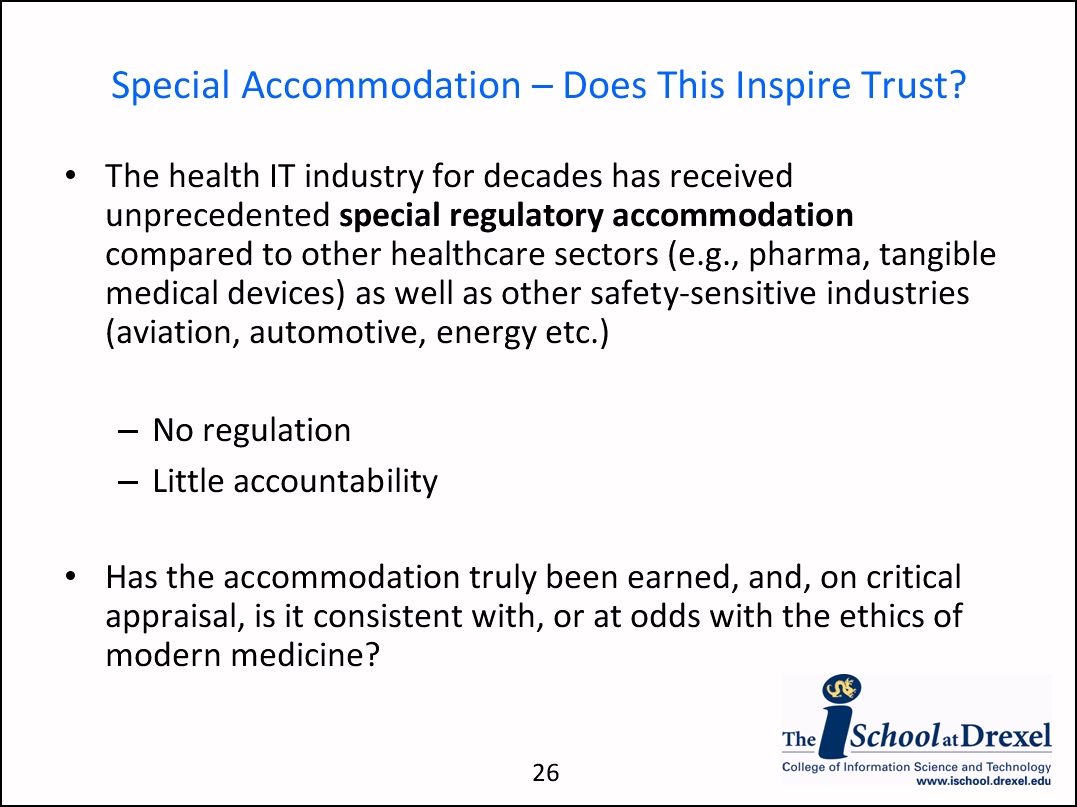
That health IT used on live patients receives special regulatory accommodation in the form of non-regulation, when clearly the quality and continued reliable performance of EHR systems are essential for the safety and effectiveness of health care delivery, is inexcusable in 2012.  

(Of course, stunningly, FDA won't touch the latter, although admitting they are medical devices that should fall under the FD&C Act, because EHRs are a "political hot potato."  See this post for the relevant citations.)

... "This has been excruciatingly painful to do what is needed for those people who need it most," said Dr. Rachel Steinhart, an emergency room doctor who worked a graveyard shift ending Tuesday morning, hours before the board meeting. She said she still had to document paperwork for 16 of her patients. "It's going to implode. It can't go on like this."

Patients are surely going to be injured or killed in this setting.  There is likely a "hold harmless" clause with the vendor, so, doctors, I'm sorry to say, despite your complaints, you will very likely be held legally liable.

The head of the county's health care system sympathizes, and hopes to work with medical staff to ease the transition for what is a monumental moment in medical history.

"We're in an era of massive change right now, not only in our system, but in the system nationwide," said Dr. William Walker, Contra Costa's health services director. "Coming with the rapidity is its throwing people off balance."

Dr. Walker has just painted a big red "name me as a defendant for gross negligence and breach of fiduciary responsibilities to patients and clinicians" target on his back for glossing over known health IT risks and what appear to be rather profound complaints coming from his constituents.  Instead, he supplies platitudes, not action to remediate or withdraw the bad IT.

Name me as a defendant for gross negligence and breach of fiduciary responsibilities to patients and clinicians


The response is stunning:

To ease the burden, Walker hopes to have teams of medical care providers formed to ease the doctors' paperwork burden, enabling them to return to treating patients.

It takes teams of physicians to properly see a patient due to the interference of EHRs?  That is remarkable.

The ccLink program has its benefits, some doctors said. Dr. Chris Farnitano, an ambulatory care medical director, described how he retrieved a patient's biopsy results from a different hospital on the spot, whereas in the past it would have taken weeks.

However, other doctors called ccLink clunky and time-consuming, designed more for bureaucrats than physicians. Even with doctors cutting their patient load in half -- meaning half as many appointments are available for patients -- doctors complained that they spend more time on their computers than treating patients.

This is misdirection by the Medical Director.  It's unarguable that the risks far outweigh the benefits.  Further, retrieving a biopsy or other result result instantaneously could easily be done from an innocuous, non-disruptive document imaging system (e.g., Documentum).  The latter would also be many millions of dollars less expensive than an EHR.

"It's a truncation of patient care. The individual patient doesn't get the care they used to get," said David MacDonald, a 22-year family medicine doctor.

Again, Dr. MacDonald, the liability for adverse outcomes is on you.

You are now, in effectm an indentured servant of an IT company, providing free alpha and beta testing at your expense and peril, using the patients as an even lower level of indentured servant/guinea pig.

There's also significant patient-endangering collateral damage from this mayhem:

The lack of appointments has overburdened emergency rooms, which already exceeded emergency room wait benchmarks in a facility built to see 80 patients a day, but often sees more than 200 patients a day. Since ccLink started, the average patient spends four hours in the ER, up an hour from before the computer system transition, which was already over national benchmarks, said Reilly.

The scenario could not be worse.  The ED's are themselves burdened by EHR's.

The supervisors asked for continued updates, and for patience.

"Continuous improvement means you need continuous change," said supervisor Federal Glover. "Eventually, it's going to become second nature as it was with cell phones. We'll wonder how we ever did without it."

Supervisor Glover has also painted a "defendant" target on his back.  This is the misdirection I was speaking of earlier, consisting of platitudes, logical fallacy and falsehoods:

  • "Continuous improvement" is not what's going on here; 
  • Such improvement does not mean creating chaos as a precondition; 
  • Whether this software will become "second nature" is anyone's guess.  That is a hysterical and logically fallacious statement (e.g., an appeal to belief) of an almost quasi-religious fanaticism regarding computing.  This technology could ultimately be scrapped in favor of, say, simpler document imaging systems due to increasing clinician complaints, inherent usability issues in fast-paced medical settings, litigation, costs, harms etc.;
  • What of the patients placed at risk, and/or injured/killed as a result of this experimentation?  What of them, and their medical and human rights?

In effect, a response like this is medically unethical.  The correct response would be a halt in the rollout until problems are substantially remediated in a controlled, risk free setting - not the clinic.

If that is not possible, the system needs to indeed be scrapped or replaced.

Continuation of patient endangerment is inexcusable medically, ethically and legally.

-- SS

Thursday, August 30, 2012

Clinicians: How to Document the EHR Screens You Encounter That Cause Concern

Healthcare IT "glitches" as reported on this blog should make any clinician - and patient - wary of the technology in its present state.

In the past, when camera film was the only image recording medium, it was often difficult to get high quality photographs of TV screens.  No longer.

Clinicians, here's a hint: it's now easy to photograph computer screens, either old CRT-based or newer flat panels, with a cellphone or other digital camera.

When you see something you are concerned about...you have the tools to document and share as necessary with the appropriate authorities, and to protect yourself.

Further, hospitals often claim they cannot show data as clinicians see it on-screen because of "print page" restrictions or due to the "oppressive burden" of someone having to do multiple screen dumps to a printer.

That excuse is no longer valid:


A screen shot of the very screen used to create this post, taken with an old 2 megapixel cellphone, default settings, no flash, ambient (dim) light, unremarkable flat screen monitor.  The same can be done for EHR, CPOE, etc.  Click to enlarge.


This example blows that Discovery-impairing excuse out of the water.

"Glitches" should be reported, and in a manner as I wrote at this post, reproduced below:

(Disclaimer:  The IT sellers and hospital corporate officials are likely to invoke IP rights regarding EHR screens and HIPAA regulations in the attempt to limit transparency about problems, for which I take no responsibility.  Use this technique with appropriate precautions with regard to information sharing.)

... When a physician or other clinician observes health IT problems, defects, malfunctions, mission hostility (e.g., poor user interfaces), significant downtimes, lost data, erroneous data, misidentified data, and so forth ... and most certainly, patient 'close calls' or actual injuries ... they should (anonymously if necessary if in a hostile management setting):

  • Inform their facility's senior management, if deemed safe and not likely to result in retaliation such as being slandered as a "disruptive physician" and/or or being subjected to sham peer review (link).
  • Inform their personal and organizational insurance carriers, in writing. Insurance carriers do not enjoy paying out for preventable IT-related medical mistakes. They have begun to become aware of HIT risks. See, for example, the essay on Norcal Mutual Insurance Company's newsletter on HIT risks at this link. (Note - many medical malpractice insurance policies can be interpreted as requiring this reporting, observed occasional guest blogger Dr. Scott Monteith in a comment to me about this post.)
  • Inform the State Medical Society and local Medical Society of your locale.
  • Inform the appropriate Board of Health for your locale.
  • If applicable (and it often is), inform the Medicare Quality Improvement Organization (QIO) of your state or region. Example: in Pennsylvania, the QIO is "Quality Insights of PA."
  • Inform a personal attorney.
  • Inform local, state and national representatives such as congressional representatives. Sen. Grassley of Iowa is aware of these issues, for example.
  • As clinicians are often forced to use health IT, at their own risk even when "certified" (link), if a healthcare organization or HIT seller is sluggish or resistant in taking corrective actions, consider taking another risk (perhaps this is for the very daring or those near the end of their clinical career). Present your organization's management with a statement for them to sign to the effect of:
"We, the undersigned, do hereby acknowledge the concerns of [Dr. Jones] about care quality issues at [Mount St. Elsewhere Hospital] regarding EHR difficulties that were reported, namely [event A, event B, event C ... etc.]

We hereby indemnify [Dr. Jones] for malpractice liability regarding patient care errors that occur due to EHR issues beyond his/her control, but within the control of hospital management, including but not limited to: [system downtimes, lost orders, missing or erroneous data, etc.] that are known to pose risk to patients. We assume responsibility for any such malpractice.

With regard to health IT and its potential negative effects on care, Dr. Jones has provided us with the Joint Commission Sentinel Events Alert on Health IT at http://www.jointcommission.org/assets/1/18/SEA_42.PDF, the IOM report on HIT safety at http://www.modernhealthcare.com/Assets/pdf/CH76254118.PDF, and the FDA Internal Memorandum on H-IT Safety Issues at http://www.scribd.com/huffpostfund/d/33754943-Internal-FDA-Report-on-Adverse-Events-Involving-Health-Information-Technology.

CMO __________ (date, time)
CIO ___________ (date, time)
CMIO _________ (date, time)
General Counsel ___________ (date, time)
etc."
  • If the hospital or organizational management refuses to sign such a waiver (and they likely will!), note the refusal, with date and time of refusal, and file away with your attorney. It could come in handy if EHR-related med mal does occur.
As EHRs remain experimental, I note that indemnifications such as the above probably belong in medical staff contracts and bylaws when EHR use is coerced.

Physicians can create health IT transparency; waiting for the industry or HHS to do so is, in my view, futile and not a patient advocacy stance.

-- SS

Aug. 31, 2012 Addendum:

I tried this method on a 20 year old, cathode ray tube-based Fisher 13" (appx.) color TV set.  Of course, this TV set is limited to a few hundred lines of resolution, and is interlaced (unlike most computer monitors after the early 1990's). Here's what I got.  Note that the picture was moving:


Old TV, old 2 MP cellphone, default settings.  Click to enlarge.

Again, old 2 MP cellphone, ambient background, default settings.  I tried several shots, and all were of similar quality.

-- SS

Monday, August 27, 2012

Health IT Amateurs, Logical Fallacy and Hospital Leadership: An Inhibitor to Good Health IT

An excellent three-part article on local providers' efforts to "join the electronic medical record/clinical IT movement", including a middle section "One doctor has reservations about EMR's design, usability", was published yesterday in the Dubuque (IA) Telegraph Herald.

I was cited as that doctor (subscription required).

The article began:

Dr. Scot Silverstein travels the country attending conferences [and other countries as well - ed.], speaking on panels and voicing concerns about health care's headlong rush into a reliance on electronic medical record systems.

"Headlong rush" is an accurate description of my beliefs, as in my "cart before the horse" posts here.

The newspaper reporter continues:

"Older and younger physicians alike are increasingly concerned about the poor design and poor usability of clinical IT," Silverstein said.  

Not only that, but so is ONC, the Institute of Medicine and the National Institute for Standards and Technology, among others, who I indicated were the source of my quotes.

The Drexel University College of Information Science and Technology faculty member calls "EMR" an anachronistic term from a time when the systems were merely storage tools for records.  "What is meant in 2012 is not just an innocuous 'filing cabinet,' but an enterprise clinical resource management and workflow control system - not just storing records, but regulating and governing all clinical behavior and action," Silverstein said.

That is, indeed, my own observation.

Silverstein contends such systems are inappropriate for some health-care environments, such as emergency rooms and intensive-care units.  "They slow down and distract clinicians due to their generally poor user interfaces, in the worst possible setting, and disrupt clinician cognition," he said.

Again, not only me.  As I had written to the reporter:

... These devices are not appropriate for high-risk, high-intensity environments such as ED's, ICU's etc.  They slow down and distract clinicians due to their generally poor user interfaces, in the worst possible setting, and disrupt clinician cognition.  But don't take my word for it.  See the 2012 report from the Institute of Medicine on healthcare IT safety (I wrote about it at http://hcrenewal.blogspot.com/2011/11/iom-report-on-health-it-safety-nix-fda.html), the National Institute of Standards and Technology report on clinical IT usability (http://hcrenewal.blogspot.com/2011/10/nist-on-ehr-mission-hostile-user.html) and the literature I collated at http://www.ischool.drexel.edu/faculty/ssilverstein/cases/?loc=cases&sloc=readinglist.

In fact, document image management systems and human data abstractors are a good tradeoff to meet the needs of the most time-pressed clinicians whose time is a hospital's most valuable asset, and to make patient charts available when and where needed.  This is as opposed to "digital data field and form-based" (i.e., conventional) EMR's that force the clinicians to waste their time in clerical functions and distract them from pressing clinical matters and informational accuracy. 

He then reports:

Silverstein defines such cognition as the decision making and problem solving necessary to provide quality health care.

Precisely.

... Silverstein thinks current clinical IT programs focus too much on raw data and not enough on supporting a physician's decision-making abilities. "As a result, valuable time and energy is spent managing data as opposed to understanding the patient," he said. "Ideally, IT systems would place raw data into context with current medical knowledge to provide clinicians with computer models that depict the health status of the patient, including information on how different organ systems are interacting, epidemiological insight into the local prevalence of disease and potential patient-specific treatment regimens."
 
Actually, it's not just that I think and said these things.  The quote came verbatim, as I had indicated, from the prestigious National Research Council of the United States and their 2009 study on health IT, led by healthcare IT pioneers Drs. Octo Barnett and William Stead.

Any time logically consistent, ethics-based, common sense observations and opinions are expressed about health IT, however, one can always rely on a pundit or hospital executive for a misdirecting, illogical, and/or impertinent comment.

The expected came from Kay Takes, vice president of patient care services at Mercy Medical Center-Dubuque:

 ... Kay Takes, vice president of patient care services at Mercy Medical Center-Dubuque, said the hospital finds electronic medical records a help in the critical environment of the ICU.

"Specifically in the ICU, in the last 13 months we've gotten enhancements that allow us to download values from the medical equipment - it's automatically pulled into the medical record," she said "It's been fantastic. The availability of the information is enormously valuable. It's been a lot more of a benefit than a hindrance."

I speak from experience, in having been involved in developing those exact same capabilities in the mid 1990's (or, most accurately, protecting patients from the dangers created by the IT department in the project), that they are a convenience to those who formerly had to collect the data manually and write it on the ICU flowsheet.

The capabilities are also a mild convenience to clinicians who view the data, although the surface area of a paper flowsheet is a great advantage in seeing more data in one's field of view at one time than the usual small computer screen (to illustrate see my Feb. 2012 post EHR Workstation Designed by Amateurs at this link and my Jan. 2012 post An 'Anecdotal Complaint' About An ICU EHR at this link).

From the latter post:

... And we do still talk to each other – but even that doesn’t always “work out”, because we’ve lost our operational minds (collectively) – the shared-by-all compact, visually all data in one place, and temporally arranged – i.e., the shared nurse/doc/resp flowsheet [traditionally in an ICU, a long tabular scroll of paper for "at a glance" patient status overview - ed.] – where everybody was looking at the same page, which we no longer are – as the team is slowly discovering.

And which required no logon for sign-over bedside rounding (~40 minutes for 20-30 babies was the allotted time). The flowsheet needed only a 10-15 second glance to spot developing problems; “the computer” is effectively inaccessible in the time allotted for the twice daily sign-n-out “rounds”.

Ultimately, though, Ms. Takes, if quoted accurately, commits the logical fallacy of ignoratio elenchi ("ignorance of refutation", missing the point) – an argument that may in itself be valid, but does not address the issue in question.

For this convenience does not at all justify the downsides of EHRs, especially in an ICU:  increased time for task completion, increased risk of errors of commission or omission, and the other risks as outlined in sources such as FDA's 2010 Internal Memo on H-IT Risks, and recently by AHRQ in their IT Hazards Manager project (Appendix B).

Let's review those risks and failure modes from the AHRQ report, all observed empirically in the real world.  From the report:

A health IT hazard is a characteristic of any health IT application or its interactions with any other health care system (e.g., the people, equipment and work spaces of an ICU) that increases the risk that care processes will be compromised and patients harmed.

The potential outcomes of these hazards include medical privacy breach/identity theft, medical misadventures such as errors of commission or omission resulting in "close calls" (errors barely averted), or patient injury, or death, stress on clinicians reducing their performance, and documentation errors or data corruption increasing the risk of errors in the short, medium or long term.  In short, nothing you'd likely desire to occur while you or a family member was a patient:

Usability
• Information hard to find
• Difficult data entry
• Excessive demands on human memory
• Sub-optimal support of teamwork (situation awareness)
• Confusing information display
• Inadequate feedback to the user
• Mismatch between real workflows and HIT
• Mismatch between user mental models/expectations and HIT

Data Quality
• IT contributed to entry of data in the wrong patient’s record
• Organizational policy contributed to entry of data in the wrong patient’s record
• Patient information/results routed to the wrong recipient
• Discrepancy between database and displayed, printed or exported data
• Faulty reference information
• Unpredictable elements of the patient’s record available only on paper/scanned documents
• Lost data
• Inaccurate natural language processing
• Virus or other malware

Decision Support
• Excessive non-specific recommendations/alerts
• Faulty recommendation
• Missing recommendation or safeguard
• Inadequate clinical content
• Inappropriate level of automation

Vendor Factors

• Sub-optimal interfaces between applications and devices
• Faulty vendor configuration recommendation
• Unusable software implementation tools
• Non-configurable software
• Inadequate vendor Testing
• Inadequate vendor software change control
• Inadequate control of user access
• Faulty software design (specification)

Local Implementation

• Faulty local configuration or programming
• Inadequate local testing
• Inadequate project management
• Inadequate software change control
• Inadequate control of user access
• Suboptimal interface management

Other factors
• Inadequate training
• Excessive workload (including cognitive)
• Inadequate organizational change management
• Inadequate management of system downtime or slowdown
• Unclear policies
• Compromised communication among clinicians (i.e., during handoffs)
• Interactions with other (non-HIT) care systems
• Physical environment (e.g., hardware location, lighting, engineering)
• Inadequately secured data
• Hardware Failure
• Use error in the absence of other factors

The convenience of automated data collection through an EMR system comes at, one might say, a slight cost that may not be realized by health IT amateurs.** 

Unfortunately, their lack of knowledge of these issues reduces the caution and "pushback" required for good health IT to become the norm, and permits bad HIT to be sold.


-- SS

** Amateurs in the sense that I am a radio amateur, not a professional, formally trained telecommunications engineer, and would never take a major role in an enterprise telecommunications project, especially a mission-critical one.

8/27/12  Addendum:

A typical, anonymous, irrational response of the type we've seen on this blog before (as for example here and here) has been posted as a comment to the newspaper story:

"nemesis" posted at 1:19 pm on Mon, Aug 27, 2012. 

He travels the country complaining about existing systems? Perhaps the good prof could spend a little time designing the ideal interface/system and see if he can get anyone interested. Surely his design would win them all over.

The problem with this type of comment, of course, is that it's logically fallacious (a form of ad hominem and an odd "appeal to perfection") and irrelevant.  It is no way responds to or refutes the issues I raise in the article.   

It likely comes from a health IT pundit of some sort, but hopefully not someone in a position of authority.  In medicine, the rule of thumb is simple:  "Critical thinking always, or your patient's dead."

-- SS

Thursday, August 9, 2012

My Presentation to the Health Informatics Society Of Australia: "Critical Thinking on Building Trusted, Transformative Medical Information: Improving Health IT as the First Step"

In early 2011 I was invited to present at the annual convention of the Health Informatics Society of Australia (HISA) by its CEO, Louise Schaper, PhD.  HISA was aware of my writings and thought a presentation at their conference would be of interest to the Australian informatics and healthcare governance community.

Dr. Schaper wrote:

From: Louise Schaper
Sent: Thursday, March 24, 2011 10:50 AM
To: Scot Silverstein
Subject: HIC invitation to deliver a keynote presentation

Hi Scot,

I trust this email finds you well and I hope spring is bringing you some warmer weather and cheer.

I wanted to let you know that the Health Informatics Conference committee met recently and expressed a high level of interest in having you deliver a keynote address at HIC and also to form part of a panel presentation. 

I know you may not be able to make a commitment to come to Australia in August, but I wanted to let you know what we would love to have you, if circumstances permit you being here.  I’m confident we could have your trip sponsored (providing you don’t mind spending some face-time with the sponsoring organisation) and generate some media coverage around your visit.

The preliminary program will be advertised in the next few weeks and at the moment I’m leaving a ‘spot’ for you in the hope that you may be able to join us.  I know you are in difficult and upsetting circumstances so please know that I’m not intending to add to any pressure – I just wanted to let you know that we would be honoured if you are able to deliver an address at HIC this year and I will keep a speaking spot reserved for you if you think you may be able to accept our invitation.

Thanks for your time Scot.  I look forward to hearing from you.

Kindest regards,

Louise

Sadly, the "difficult and upsetting circumstances" she mentioned were my involvement in caring for my mother, seriously injured in May 2010 in a healthcare information technology-related medical misadventure and, by this time, dying.

I was thus unable to attend.

My mother passed away June 6, 2011 of her injuries.

In January 2012, Dr. Schaper was gracious enough to re-invite me to the annual 2012 conference in Sydney.  I accepted.

I attended HIC 2012, held in the Darling Harbour Convention Centre in Sydney 30 July - 2 August 2012.


I enjoyed taking pictures like this with my trusty (and portable) Canon SX110 IS.  Click to enlarge.  More photos here.

My powerpoint slides for the presentation entitled "Critical Thinking on Building Trusted, Transformative Medical Information:  Improving Health IT as the First Step" are at this link.


Darling Harbour Convention Centre, Sydney, Australia. Click to enlarge.

Australia has embarked on a national Personally Controlled Electronic Health Record (PCEHR) project under the auspices of Nehta, the National E-Health Transition Authority.  I find this an interesting approach to national health IT; unlike the U.S., whose project is top-down (centrally controlled records), Australia seems to have learned from our mistakes and is initiating health IT as a bottom-up (patient-controlled) initiative.

At the conference last week, I delivered a keynote address on the theme of improving health IT as an essential step in leveraging the capabilities of the technology.

Being that I am anti-"bad IT" and pro-"good IT", implicit in my address was the issue of the technology's untrustworthiness in 2012, largely due to the unregulated free-for-all its market represents and the poor engineering that is the result.

I also participated in a Panel Discussion led by Australian investigative journalist and popular political TV program host Tony Jones.  Mr. Jones hosts the Australian Broadcasting Corporation's "Q&A - Adventures in Democracy."


Panel discussion moderated by Australian political commentator Tony Jones, who hosts the show "Q&A" on the Australian Broadcasting Corporation.  Click to enlarge.


I will highlight several key points I made in my keynote and on the panel:

  • Critical thinking is essential at all times in healthcare ... or your patient's dead.
  • Critical thinking is not mindless criticism; on the contrary, it is reflective, inquisitive, logical thinking that is focused on deciding what to believe or do.
  • Health IT must be trusted by users and patients [and be free of major downsides] - as a primary step before HIT can optimally benefit healthcare 
  • I pointed out I am not suggesting anything new and that, in fact, I am suggesting something old:  "First, do no harm."
  • I pointed out the "revolutions" usually have downsides, and IT always produces winners...and losers (per the empirical research of Social Informatics). 

Me presenting my keynote, driving home the point that IT on its own won't "revolutionize" healthcare; it is a tool to facilitate the true enablers of healthcare - clinicians - a point that should never be forgotten.  Click to enlarge. From the excellent multimedia piece on the conference at this link.


I then posed a series of questions of great relevance to understanding health IT realities.  Click to enlarge:


I left it to the audience to answer these questions.

I then posed the question "Is health IT being done well?"

I provided links to various evidence that it was not, such as the National Research Council 2009 report on health IT; AMIA's report on its workshop on healthcare IT failure, the 2012 U.S. IOM report on safety, the 2012 U.S. NIST report on usability, work by Australian Professor Jon Patrick of U. Sydney on health IT defects, and other sources as aggregated at this link.

Again, I did not impose views on the audience.  I didn't need to, as that corpus speaks for itself.

I also clarified terminology that reduces essential caution, such as the terms "electronic medical record" (EMR) and "electronic health record" (EHR) - a source of endless, wasted contention on definitions of which is which - being anachronisms from an earlier age of IT.  I pointed out that in 2012 what these innocuous terms somewhat deceptively and disarmingly represent are in reality complex enterprise clinical resource management and clinician workflow control systems – where many, many things can go wrong.


"EHR":  an innocuous "file cabinet" for records, or something else entirely?  Click to enlarge.


I asked if case reports of health IT unintended consequences (UC’s) were “anecdotal” and to be played down, while studies of health IT benefits to date solid science.  I then asked if the reality might be that studies of health IT benefits to date were mostly anecdotal (e.g., in specialized settings; weak observational studies vs. randomized clinical trials) while reports of UC’s are risk management-relevant incident report “red flags” pointing to possible systemic problems.

I pointed out the common seller marketing memes of beneficence and deterministic efficacy, and asked if these were realistic.  I also pointed out the need for transparency about HIT risks, and the impediments to this transparency.

Finally, I indicated what was the likely problem affecting all countries involved in EHR projects: that the rigor, ethics and skepticism of medical science itself not applied in the domain of health IT.

I suggested a simple solution:  a paradigm shift in thinking about health IT as another medical device, that needed to be subject to the same methodologies and ethical considerations applicable for decades (or more) in the healthcare delivery sector such as medical devices, pharmaceuticals, and research (and other risk-prone industries e.g., aviation and automotive).

My goal was to provoke thinking about these issues, to circumvent blank, uncritical acceptance of industry and industry-supporter memes.

I believe I succeeded.  Feedback I received was that the audience, including government officials, found many new things to consider as they embark on their national health IT projects.

I also heard that some HIT seller representatives were squirming a bit.  That was not unexpected.  I was taking "control of their message" away from them.


University of Sydney Professor Jon Patrick presenting on computational linguistics.   Jon is the author of a treatise on health IT defects (at this link), mentioned numerous times on this blog.  Click to enlarge.

Finally, I had a question from the audience, from fellow blogger Matthew Holt of the Health Care Blog.  (I've had some online debate with him before, such as in the comment thread at my April 2012 post here.)

Matthew asked me a somewhat hostile question (perhaps in retaliation for the thrashing he received at the end of my May 2009 post on the WaPo's HIT Lobby article here), that I was well prepared for, expecting a question along these lines from the seller community, actually.  The question was preceded by a bit of a soliloquy of the "You're trying to stop innovation through regulation" type, with a tad of Merck/VIOXX ad hominem thrown in (I ran Merck Research Labs' Biomedical libraries and IT group in 2000-2003).

His question was along the lines of - you were at Merck; VIOXX was bad; health IT allowed discovery of the VIOXX problem by Kaiser several years before anyone else; you're trying to halt IT innovation via demanding regulation of the technology thus harming such capabilities and other innovations.

The audience was visibly unsettled.  Someone even hollered out their disapproval of the question.

My response was along the lines that:

  • VIOXX was certainly not Merck at its best, but regulation didn't stop Merck from "revolutionizing" asthma and osteoporosis via Singulair and Fosamax;
  • That I'm certainly not against innovation; I'm highly pro-innovation;
  • That our definitions of "innovation" in medicine might differ, in that innovation without adherence to medical ethics is not really innovation.  It is exploitation.

(I forgot to mention that I gave an invited presentation to Merck's Drug Surveillance department in 2006, PPT here, long after I was their employee, on the potential use of EHR data to detect drug adverse events sooner than traditional phase IV studies or ad-hoc reporting allowed.)

When I spoke of medical innovation requiring ethics, nearly the full audience at my keynote address - hundreds of people - broke out in applause.

•
I knew at that point that my talk was a success.


This author with HISA CEO Louise Schaper , PhD. Click to enlarge.

More photos of my trip are here.

-- SS

Addendum:  Another added pleasure in my visit Down Under. As Australia and the U.S. respect each other's amateur radio licenses, I was able to operate my handheld radio as "KU3E portable Victor-Kilo." VK is the international radio prefix for Oz.  Contacting Australia from the U.S. is considered a "holy grail" of ham radio.  It was interesting to hear amateur radio "from the other end."


Yaesu VX-3 Multiband Transceiver

-- SS

Aug. 11, 2012 Addendum:

An excellent multimedia video of HIC 2012 produced as the conference proceeded has been posted on YouTube at http://www.youtube.com/watch?v=DZg_46wY0E0.  It was finished and shown immediately after the conference's conclusion.

-- SS

Monday, July 23, 2012

Health IT FDA Recall: Philips Xcelera Connect - Incomplete Information Arriving From Other Systems

Another health IT FDA recall notice, this time on middleware, an interface engine that routes data:

Week of July 11

Product description:  

Philips Xcelera Connect, Software R2.1 L 1 SP2, an interface engine for data exchange [a specialized computer and accompanying software package - ed.]. Philips Xcelera Connect R2.x is a generic interface and data mapping engine between a Hospital Information System (HIS), Imaging Modalities, Xcelera PACS and Xcelera Cath Lab Manager (CLM). This interface engine simplifies the connection by serving as a central point for data exchange. The data consists only of demographic patient information, schedules, textual information and text reports.

Classification:  Class II

Reason For Recall Xcelera Connect R2.1 L 1 SP2 , incomplete information arriving from unformatted reports interface

The data consists "only" of demographic patient information, schedules, textual information and text reports?

This is a dangerous fault mode, indeed.

"Incomplete information" moving between a hospital information system, imaging systems, a PACS system used to manage the images, and a cardiac cath lab can lead to very bad outcomes (and million dollar lawsuits), such as at "Babies' deaths spotlight safety risks linked to computerized systems", second example.

Note that the interface engine is in release 2.1, level 1, service pack 2.

In other words, a critical hardware/software product such as this undergoes constant tweaking (like Windows).

As a Class II device, at least the software is vetted to some degree by FDA:

Class II devices are those for which general controls alone are insufficient to assure safety and effectiveness, and existing methods are available to provide such assurances.[8][10] In addition to complying with general controls, Class II devices are also subject to special controls.[10] A few Class II devices are exempt from the premarket notification.[10] Special controls may include special labeling requirements, mandatory performance standards and postmarket surveillance.[10] Devices in Class II are held to a higher level of assurance than Class I devices, and are designed to perform as indicated without causing injury or harm to patient or user. Examples of Class II devices include powered wheelchairs, infusion pumps, and surgical drapes.[8][10]

One wonders how testing of tweaks and updates to this product is done, if at all, other than on live and unsuspecting patients.

When you go into the hospital you are not just putting your life in the hands of the doctors and nurses, you're putting your life into the hands of computer geeks and software development experiments.

-- SS

July 25, 2012 Addendum:

The WSJ covered this here:  http://blogs.wsj.com/cio/2012/07/20/philips-recalls-flawed-patient-data-system/.  From their report:

... The problem that led to the recall: hitting the “enter” button, to start a new paragraph, in the summary field of heart test reports, sometimes caused the text entered below that point to be stripped from the report as it was transmitted into the patient’s electronic health record. And doctors later reviewing the patient’s electronic health record would not necessarily know they had received only part of the report, which could lead them to make “incorrect treatment decisions,” Philips said in a letter to hospitals.

...  Mike Davis, managing director at The Advisory Board Company, a healthcare research firm, says in the case of the Xcelera Connect, Philips should have caught the problem in testing. “How the hell does this get out? It shows there wasn’t good quality assurance processes in place.”

Indeed.

-- SS