Showing posts with label Healthcare IT. Show all posts

Thursday, June 28, 2012

FDA Safety and Innovation Act: To contain an "Appropriate, risk-based regulatory framework pertaining to health information technology"

Congress has just released an an Act "to amend the Federal Food, Drug, and Cosmetic (FD&C) Act to revise and extend the user-fee programs for prescription drugs and medical devices, to establish userfee programs for generic drugs and biosimilars, and for other purposes."  Health IT provisions are included.

This Act, S. 3187, is entitled the ‘‘Food and Drug Administration Safety and Innovation Act.’’  PDF fulltext is located at this link:  http://www.gpo.gov/fdsys/pkg/BILLS-112s3187enr/pdf/BILLS-112s3187enr.pdf

With regard to health IT, the Act states the following.  A risk-based regulatory framework pertaining to health IT is to be developed (emphases mine):


SEC. 618. HEALTH INFORMATION TECHNOLOGY.


(a) REPORT.—Not later than 18 months after the date of enactment of this Act, the Secretary of Health and Human Services (referred to in this section as the ‘‘Secretary’’), acting through the Commissioner of Food and Drugs, and in consultation with the National Coordinator for Health Information Technology and the Chairman of the Federal Communications Commission, shall post on the Internet Web sites of the Food and Drug Administration, the Federal Communications Commission, and the Office of the National Coordinator for Health Information Technology, a report that contains a proposed strategy and recommendations on an appropriate, risk-based regulatory framework pertaining to health information technology, including mobile medical applications, that promotes innovation, protects patient safety, and avoids regulatory duplication.


(b) WORKING GROUP.—
(1) IN GENERAL.—In carrying out subsection (a), the Secretary may convene a working group of external stakeholders and experts to provide appropriate input on the strategy and recommendations required for the report under subsection (a).

(2) REPRESENTATIVES.—If the Secretary convenes the working group under paragraph (1), the Secretary, in consultation with the Commissioner of Food and Drugs, the National Coordinator for Health Information Technology, and the Chairman of the Federal Communications Commission, shall determine the number of representatives participating in the working group, and shall, to the extent practicable, ensure that the working group is geographically diverse and includes representatives of patients, consumers, health care providers, startup companies, health plans or other third-party payers, venture capital investors, information technology vendors, health information technology vendors, small businesses, purchasers, employers, and other stakeholders with relevant expertise, as determined by the Secretary.


While a welcome development, it is to be determined if the Working Group representatives will include critical thinkers without conflict of interest, whose contributions to the health IT debate in this country are needed a lot more than the traditional hyper-enthusiasts, industry courtiers and opportunists.

I am actually not hopeful.

The "promotes innovation" and "avoids regulatory duplication" phrases are of especially great concern.  As I've written before, "innovation" that involves non-consented experimentation is not innovation at all, it is exploitation, and "regulatory duplication" can become an excuse for milquetoast regulation by the conflicted (e.g., regulatory capture) or poorly qualified.

I also note that this Act, while welcome, is long overdue - another example of putting the cart before the horse (link), with a national project (including CMS penalties for non-adopters) now several years underway.

Final thought:  if health IT were safe as has been claimed now for decades, or had been made safe through proper development and clinical trials-based testing, we would not need health IT provisions in a  "Food and Drug Administration Safety and Innovation Act" in 2012.

-- SS

Friday, April 27, 2012

Allscripts shares plunge on weak outlook, board changes, unhappy customers - but mostly unhappy customers, I surmise

Glen Tullman is CEO of the health IT seller Allscripts-Misys Healthcare.  He was an advisor to the Obama campaign on health information technology issues.

My organization had to sue his company for non-working products a few years ago (link to PDF of civil complaint) .

Apparently other customers were unhappy as well.  This from Reuters:

Allscripts shares plunge on weak outlook, board changes

Fri Apr 27, 2012 9:24am EDT

(Reuters) - Allscripts Healthcare Solutions Inc's shares plunged 42 percent in premarket trade on Friday, after the company forecast weak full-year earnings, hurt by software development costs and weaker bookings.

On Thursday, the healthcare information technology provider reported a lower-than-expected quarterly profit and also announced the resignation of its CFO, three directors and board Chairman Phil Pead.

Citigroup analyst George Hill said the results were strongly disappointing and downgraded the company's stock to "neutral" from "buy."

Hill said he was most troubled by the loss of long tenured CFO Bill Davis, who had been the public face of Allscripts to investors for many years.

"We suspect CEO Glen Tullman won a power struggle at the 11th hour leading to the board departures," Hill said.

"Too few customers are buying its products, due to lack of confidence or satisfaction," Barclays Capital analyst Lawrence Marsh wrote in a note.

Allscripts shares were trading at $9.27 in premarket trade. They had closed at $16.02 Thursday on the Nasdaq.

(Reporting by Shailesh Kuber in Bangalore; Editing by Joyjeet Das)

The statement 'too few customers are buying its products, due to lack of confidence or satisfaction', speaks volumes about the state of health IT in general in 2012.

That state includes eventual regulation after an IOM report on dubious safety, mission hostile user interfaces as identified by NIST and others that will require expensive remediation (due to the industry arrogantly ignoring this crucial issue for decades), 'glitches' due to poor or non-existent validation and quality control that will increasingly result in expensive litigation when patients are harmed, likely government investigations and clawbacks due to EHR-promoted upcoding, and an increasing awareness that many of the so-called miracle 'revolutionary' gains (as opposed to facilitation of medical practice) are largely illusory industry-promoted memes not based on robust, scientifically-generated evidence.

I'd pull out of this market - if I had any money invested in it.  I have none, and never have, because I have great lack of confidence in the industry that began when I was first exposed to it and its leaders - that being in 1992.

I note that the HITECH component of ARRA, containing incentives and penalties related to health care information technology designed to accelerate the adoption of EHR systems, was advanced largely via advice to the President on the wonders of health IT.  (I thought HITECH was a reckless, premature move destined to waste billions of dollars as did the erstwhile NPfIT in the NHS, and I still stand by that prediction.)

-- SS

4/27/12 Addendum:

EHR glitches like this and this never seem to affect patients...

-- SS

Monday, February 27, 2012

True or Not? Death By Deletion, Adventist Health System IT Whistleblower Patricia Moleski Speaks Out

Not sure what to make of this yet:


A former hospital IT worker claims very deliberate mass spoliation (e.g., deletion) of electronic medical record evidence to limit her (ex)-employer's liability for EHR-related medical malpractice on patients and injured workers who were entitled to workers compensation, as well as EHR defects.

She alleges that IT personnel are used as naïve accomplices to perform the spoliation acts. She grew suspicious when she was asked to delete nursing information about a patient who committed suicide by jumping out a hospital window after an EHR-related drug overdose.

The video is over an hour long and is worth listening to.

She made these claims to the FBI and alleged to have suffered retaliation including firing, and possible terroristic activities directed against her.

A Feb. 2010 letter to Gov. Crist, Sen. Grassley and many other government officials, a 9th Judicial Circuit court document for Orange County, FL (PDF), and other details - some scary - can be found via a google search on this person's name: https://www.google.com/search?q=Patricia%20Moleski .


A Feb. 2010 letter to Sen. Grassley, former Fla. Governor Crist, various other senators, news media, etc. alleging serious, systematic, purposeful HIT evidence tampering and erasure. Click to bring up full letter.


This could be the "Libby Zion" (or Bernard Madoff?) case of the health IT world if these allegations are true.

-- SS

Wednesday, February 8, 2012

Health IT: Ddulites and Irrational Exuberance

The title is not a typo.

I've often tried to explain the phenomenon of irrational exuberance where computers are concerned, especially in the domain of health IT.

In face of the literature references provided throughout this blog, including at posts such as this reading list and at sites such as here, one would think rational people would temper their exuberance somewhat, at the very least towards rapid national rollouts - as opposed to constrained, controlled experiments until the industry learns how to get the technology "right."

However, more than a decade of writing has had little effect.

I've also attempted to explain the phenomenon of irrational exuberance on a belief in technological determinism, on industry propaganda, on unquestioning IT faith being a quasi-"religion", and on profiteering or other quid pro quo. (The latter, I'm certain, is operative to an extent.)

I have now come across a term, though, that I believe accurately encapsulates the phenomenon of unquestioning beliefs that health IT + clinician automagically --> a "revolution" in medicine.

It may be a character trait. The trait has been described by the term "Ddulite." (Pronounced, I would say, 'da-dew-light'.) It is obviously a play on "Luddite" with the fist four characters backwards.

Apart from its historical meaning, a Luddite is "one who is opposed to change, especially technological change" (Merriam-Webster).

A Ddulite, on the other hand, is the opposite of a Luddite. A Ddulite is:


A person who prefers new tech to old tech even when the old tech is better--more functional

or alternately:


A person with a preference for higher tech solutions even in cases where lower tech alternatives have greater and more appropriate functionality.

My own definition, especially in healthcare:


Hyper-enthusiastic technophiles who either deliberately ignore or are blinded to technology's downsides, ethical issues, and repeated local and mass failures. [1]

Such people ignore the downsides, even if the downsides are deadly - in which case I believe it justified to describe Ddulites as "radical technophiles."

The Ddulite simply assumes if it's new technology, it has to be better, no matter the evidence because, well, it's new technology.

In other words, irrational exuberance in IT in general, and HIT specifically, is not merely a belief, it's a character trait, perhaps an ideology.

That could help explain why some otherwise very bright people, even people who promote evidence-based medical practice, seem to become blind and deaf in regard to HIT, as in the recent comment thread on my post "KevinMD: How algorithm driven medicine can affect (make more dangerous, actually) patient care."

When it comes to evidence-based IT practice, a Ddulite is eager to provide extraordinary special accommodation towards IT flaws, ethics, known dangers, etc. Someone of this ideology finds it exceptionally easy to dismiss or ignore any and all evidence that could contradict the technology's powers to "transform" medicine, and perhaps even worse (for patients), that could contradict its infallible beneficence.

Unfortunately, IT is not a magic bullet ... it can be just a bullet, period, unless "done well", an undertaking of almost wicked complexity.

Being a Ddulite can, in fact, lead to recklessness and negligence. A transition to IT must always respect the findings of Social Informatics (PDF): see especially Sec. 3.1 'Key Social Informatics Ideas' starting on pg. 117. The transition must be done - especially in a scientific domain - in a scientific manner.

In medicine, that means applying the rigors of medical research, medical science and medical ethics to the conception, design, implementation and lifecycle of health IT, with all that implies. This is certainly not the state of the HIT enterprise in 2012, which is largely based on a management information systems, i.e. merchant-computing, paradigm.

People who offer unquestioning loyalty to cybernetics, and who reflexively accuse those who are circumspect about commercial health IT of being "Luddites" who proffer "anecdotes", perhaps need to look in the mirror. They then need to think critically as to whether their reflection demonstrates Ddulite characteristics.

Unquestioning loyalty to the Empire: In A Mirror, Darkly

-- SS

Feb. 19, 2012 addendum:

Also see my post "Health IT Ddulites and Disregard for the Rights of Others" that adds another observation about the Ddulite mindset.

Notes:

[1] On mass IT failures repeatedly ignored, see "Pessimism, Computer Failure, and Information Systems Development in the Public Sector", Shaun Goldfinch, University of Otago, New Zealand, Public Administration Review 67;5:917-929, Sept/Oct. 2007.

Tuesday, February 7, 2012

Perhaps Hospitals Don't Care Much That EHRs Can Be Dangerous, Because EHRs Lets them Attract 'Good Paying Customers' And Exclude the Old and Poor

This comes as no surprise to me. I believe it may help explain hospital's cavalier attitudes towards the risks of today's commercial health IT.

It's all about money.

We already knew that (for example, see my Feb. 2011 post "Does EHR-Incited Upcoding (Also Known as 'Fraud') Need Investigation by CMS, And Could it Explain HIT Irrational Exuberance?"), but the following news adds to the pecuniary motivations:

Kaiser Health News

Critics say hospitals cherry pick best-paying patients
By Phil Galewitz
KHN Staff Writer

Feb 05, 2012

When the oversized postcard arrived last August from Provena St. Joseph Medical Center promoting a lung cancer screening for current or former smokers over 55, Steven Boyd wondered how the hospital had found him.

Boyd, 59, of Joliet, Ill., had smoked for decades, as had his wife, Karol.

Provena didn't send the mailing to everyone who lived near the hospital, just those who had a stronger likelihood of having smoked based on their age, income, insurance status and other demographic criteria.

The nonprofit center is one of a growing number of hospitals using their patients' health and financial records to help pitch their most lucrative services, such as cancer, heart and orthopedic care. As part of these direct mail campaigns, they are also buying detailed information about local residents compiled by consumer marketing firms — everything from age, income and marital status to shopping habits and whether they have children or pets at home.

Hospitals say they are promoting needed services, such as cancer screenings and cholesterol tests, but they often use the data to target patients with private health insurance, which typically pay higher rates than government coverage. At an industry conference last year, Provena Health marketing executive Lisa Lagger said such efforts had helped attract higher-paying patients, including those covered by "profitable Blue Cross and less Medicare."

Not to mention helping exclude those covered by Medicaid, or the uninsured.

Strategy Draws Fire

While the strategies are increasing revenues, they are drawing fire from patient advocates and privacy groups, who criticize the hospitals for using private medical records to pursue profits.


I don't recall anywhere on the releases at area hospitals saying they would be using their own clinical data for marketing purposes (which likely involve third party contractors). It might be in the fine print, however. I also don't recall any place to sign and give informed consent to the use of experimental medical devices such as the EHR's used to collect the marketing data, either, but that's addressed elsewhere on this blog such as here.


Doug Heller, executive director of Consumer Watchdog, a California-based consumer advocacy group, says he is bothered by efforts to "cherry pick" the best-paying patients.

"When marketing is picking and choosing based on people's financial status, it is inherently discriminating against patients who have every right and need for medical information," Heller says. "This is another example of how our health system has gone off the rails."


I would go beyond "off the rails." How about, straight to perverse? EHR data is used to attract paying customers and then expose them to risk of being maimed due to the disruptive nature of the HIT itself.

Deven McGraw, director of the health privacy project at the Center for Democracy and Technology in Washington, says federal law allows hospitals to use confidential medical records to inform patients about things that may help them.

"If it's technically legal, we can do it, and who gives a damn about the ethics?" is what is being expressed here.

"You want health providers to communicate to patients about health options that may be beneficial to their health," McGraw says. "But sometimes this is about generating business for a new piece of equipment that the hospital just bought."

Using such information for marketing "creeps closer to the line," between what is legal and what is not, she says.


And helping recoup the costs of that hundred-million dollar EHR setup, too.


... Tess Niehaus, vice president of marketing at St. Anthony’s Medical Center in St. Louis, says the approach has been quite successful and makes no apologies for going after the most lucrative business.

"We are here to serve everybody but we market for good paying patients because it preserves our ability to serve everyone," she says. [And the ability to proffer generous executive salaries and raises - ed.]


"Good paying patients?" Does that imply there are bad paying patients? (Might those "bad paying patients" be predominantly the elderly and/or minorities?)

While the practice is legal, most people would be shocked to know their records may be shared with nonmedical personnel and outside firms to help hospitals attract business, says Pam Dixon, executive director of the World Privacy Forum, an advocacy group based in California. "I am really bothered by the overabundance of information that is flowing that is unnecessary and risky," she says.

As I've written before, don't worry, your most sensitive data's safe in the hands of the extremely skilled health IT professionals at most hospitals.

While hospitals may profit from offering cholesterol tests and mammograms, the big payoff is in what those screenings may lead to – additional tests and procedures, including surgery.

"It's all about downstream revenue," says Patrick Kane, senior vice president of marketing at Cape Cod Healthcare in Massachusetts who used such approaches at Wellmont Health System in Kingsport, Tenn. "The old adage in business is that it’s easier to sell an existing customer new services, rather than find a new customer."


So much for medical professionalism and conservatism. At least Mr. Kane admits it's all about money.

... Provena's Lagger says the approach boosted the system's bottom line so it could serve people regardless of insurance status. "This is a means to an end," she says.

The ends don't always justify the means, but that may be a hard concept for some in today's amoral culture to understand.

... Much of the expertise for such campaigns is provided by three consulting firms -- CPM Marketing of Madison, Wis., Medseek of Birmingham Ala. and New York-based Thomson Reuters. They typically charge hospitals $100,000 a year or more.

CPM, which merged in November with Denver, Colo.-based HealthGrades, a health ratings firm, added 100 new hospitals last year to give it a total of 400. Medseek works with more than 250 hospitals and Thomson Reuters, with 150.


Remember Darrin Stevens on Bewitched? "Larry, I've got a great idea for a new campaign! Let's troll for patients using their private data! Never mind that I have donkey ears today... that darn mother in law of mine, Endora!"

The targeting worked in the case of Boyd, who called the number on the back and scheduled the CT scan a few days later. The $169 test showed his lungs were clear, but found potential blockages in coronary arteries that his Provena-affiliated doctor is monitoring.

"In hindsight, I’m glad I had the test," he says.


No mention of patients who had unnecessary testing and interventions that led to bad outcomes ... or patients injured by the very EHR systems that make such marketing possible.

-- SS

Saturday, December 17, 2011

A comment posted to the website "Doctors Helping Doctors Transform Healthcare", Peter Basch, William Bria et al.

A new website has appeared that purports to be:

A collaborative effort led primarily by doctors for doctors to provide a "trusted resource" for physicians as they work to transform health care - initially through the use of health IT.

The site is entitled "Doctors Helping Doctors Transform Health Care" and is at this link. (I note that when one encounters such platitudinous and potentially highly ideological titles, one should ask "transform how, and into what, exactly?" I presume "transform" means, in part, to reduce risk and improve safety and outcomes - while protecting patient and physician rights.)

The site has a significant number of people on their advisory board (link), but no information on compensation. I note there are industry people involved, representing a potential conflict of interest.

According to one of the principals, Peter Basch, MD, Medical Director, Ambulatory EHR and Health Information Technology Policy, MedStar Health, Washington, DC, on funding:

A Few Words About Our Supporters

It takes resources to create and maintain this site, to make the work of Doctors Helping Doctors possible. We have solicited unrestricted contributions from individuals and organizations who believe in our mission and are able to support its work. In particular, we wish to thank Patrick Soon-Shiong of the Chan Soon-Shiong Family Foundation, John Glaser of Siemens Health Services; and Andy Slavitt of Optum’s Institute for Sustainable Health.


To my knowledge, I've never met Dr. Basch, but at meetings I have met one of the other principals of the new website, William Bria, III, MD, Chief Medical Information Officer, Shriners Hospitals for Children; President and Co-Founder, Association of Medical Directors of Information Systems (AMDIS), St. Petersburg, FL.

Dr. Basch's writing has appeared at Healthcare Renewal before, such as at the Jan. 2009 post "Throwing The National Research Council Report On Health IT Under The Bus, Part 1: MedStar Health."

In the new site, Dr. Basch states that:

As early adopters, EHR implementers, and practicing physicians, we have seen the “bad and the ugly” as well as the promise of health IT. We understand how health IT can and should be used to make care better, safer, and more value-laden. As such, we believe that unnecessarily harsh criticism of Meaningful Use—which we have heard from some quarters—and uncritical cheerleading—which we have also heard—are equally unhelpful.

We see physician “extremism” essentially marginalizing what is needed now more than ever—a clear and constructive physician voice, articulating not for compliance with Meaningful Use, but rather leveraging the opportunity that Meaningful Use presents, and consistently inserting the highest ideals that led us all to choose a career in medicine.

While on the surface this is not an unreasonable position, I fear the word "extremism" is used as a metaphor for those who express genuinely critical appraisals of the state of health IT as it now exists, on issues regarding safety, efficacy, usability, need for regulation, vendor, buyer and user liability, and other "unpleasant" topics.

I do note precious little on the site about educating physicians on the considerable downsides of health IT as it currently exists, nor on the scientific literature expressing doubts about its safety, efficacy, usability, ROI and other issues (such as here).

There is, it would seem obvious, no ethical excuse for introducing medical devices and other technology of unknown benefit and of unknown risk magnitude (as recently reported by the IOM, see this post), that is unregulated, into life-critical domains such as medicine without explicit acknowledgement of experimentation. Human subjects experimentation requires, of course, explicit informed consent under the many guidelines formulated as a result of past systemic abuses. Also, users need to be fully aware of the risks.

Such informed consent cannot be accomplished, and awareness attained by physicians regarding the dangers of use of health IT in its present form, through simple "best practices" protagonism.

For instance, health IT can be inherently defective and/or mission hostile (worse, the industry is unregulated), and can injure or kill. Several illustrative examples just off the top of my head are at:


Not even including privacy and confidentiality issues (see this query link on those issues), should physicians, nurses, patients and other stakeholders not be explicitly educated on the issues of risk, that can be greatly replicated/amplified across hundreds or thousands of patients by EHRs as opposed to paper, and on actual injuries and deaths that have occured? If not, why not?

Are not these issues and the issue of the lack of a culture of safety in the health IT field at least as important, if not more important for clinicians, patients, healthcare executives and other stakeholders to be strongly aware of than "best practices" and "meaningful use?"

(I note that the "negative reports are mere anecdotes" argument commonly used by health IT pundits only shows, as in the Aug. 2011 essay by a senior clinician in Australia "From a Senior Clinician Down Under: Anecdotes and Medicine, We are Actually Talking About Two Different Things", that those making that argument need to attend revision courses in research methodology and risk management.)

In consideration of the "Doctors Helping Doctors" site's seemingly uncritical pro-HIT advocacy, I have posted the following note at the end of Dr. Basch's introductory essay. The comment appears at this link and is awaiting moderation.

The comment's remaining online would be a sign that the site is not another attempt to "control the channel", and is truly serious about being "trusted." It would be a sign of a site truly concerned with "physicians helping physicians transform health care" while not sacrificing patients as unconsenting test subjects of unregulated, experimental software-based medical devices in the process.

S Silverstein MD says:
Doctors,

One way to help doctors transform healthcare would be to educate them on the downsides of information technology in healthcare, how to avoid them, and the conflicting literature on benefits (e.g., as at http://www.ischool.drexel.edu/faculty/ssilverstein/cases/?loc=cases&sloc=readinglist).

I do not see such information here yet.

I do expect some such information will follow.

Sincerely,

Scot Silverstein

---------------------------------------------------
Scot M. Silverstein, MD
Consultant/Independent Expert Witness in Healthcare Informatics (May 2010-present)
Adjunct faculty in Healthcare Informatics and IT (Sept. 2007-present)
Assistant Professor of Healthcare Informatics and IT, and Director, Institute for Healthcare Informatics (2005-7)

Drexel University
College of Information Science and Technology
3141 Chestnut St., Philadelphia, PA 19104-2875

Email: sms88 AT drexel DOT e-d-u
Bio: http://www.ischool.drexel.edu/faculty/ssilverstein/biography.htm
Common Examples of Healthcare IT Difficulties: http://www.ischool.drexel.edu/faculty/ssilverstein/cases/

Note: I am cross-posting this comment on Healthcare Renewal blog under the title "A comment posted to the website 'Doctors Helping Doctors Transform Healthcare, Peter Basch, William Bria et al.'"

It is my hope the comment stays, and receives a reasoned reply.

-- SS

Dec. 23, 2011 addendum:

My comment appears to have disappeared. I leave it to the reader to determine what that means about the site "Doctors Helping Doctors Transform Healthcare."

-- SS

Friday, March 11, 2011

Is Microsoft slowly edging towards an "exit stage left" in health IT?

Interesting item seen here:

From Dabney: “Re: former Sentillion exec departures from Microsoft. Microsoft transferred their 800 Health Solutions Group people into the small-to-medium commercial sector group (Microsoft Business Solutions) last Monday. Peter Neupert and his whole organization have been pushed out of the incubation group in Microsoft Research with the guys who sell Microsoft Axapta ERP and CRM for small commercial customers. That will mark the end of acquisitions and spending of Microsoft on health because they haven’t had any significant sales of Amalga UIS in the past year after already withdrawing Amalga HIS and Amalga RIS/PACS from the market. Microsoft is slowly edging towards an exit stage left in health IT.

Why would this not surprise me if true?

Because I predicted it.

In July 2006, nearly 5 years ago, in my July 2006 post "Bill, Have You Lost Your Mind?"

Nobody was listening, just as nobody seems to be listening to my current dire predictions for the National Program for IT in the HHS™ .

Wait until 2016...

-- SS

Wednesday, March 9, 2011

ONC: "The Benefits Of Health Information Technology: A Review Of The Recent Literature Shows Predominantly Positive Results"

The Office of the National Coordinator for Health IT in the US (ONC) has just published an article in "Health Affairs" entitled "The Benefits Of Health Information Technology: A Review Of The Recent Literature Shows Predominantly Positive Results", Buntin, Burke, Hoaglin and Blumenthal, Health Affairs, 30, no.3 (2011):464-471, doi: 10.1377/hlthaff.2011.0178.

It is available at the hyperlink above, but may not be publicly accessible.

The authors all are, or were, ONC officials:

Melinda Beeuwkes Buntin (Melinda.buntin@hhs.gov) is director of the Office of Economic Analysis, Evaluation, and Modeling, Office of the National Coordinator for Health Information Technology (ONC), Department of Health and Human Services, in Washington, D.C. Matthew F. Burke is a policy analyst at the ONC. Michael C. Hoaglin is a former policy analyst at the ONC. David Blumenthal is the national coordinator for health information technology.

The abstract is as follows:

ABSTRACT
An unprecedented [indeed- ed.] federal effort is under way to boost [coerce? - ed.] the adoption of electronic health records and spur innovation in health care delivery.We reviewed the recent literature on health information technology to determine its effect on outcomes, including quality, efficiency, and provider satisfaction.We found that 92 percent of the recent articles on health information technology reached conclusions that were positive overall. We also found that the benefits of the technology are beginning to emerge in smaller practices and organizations, as well as in large organizations that were early adopters. However, dissatisfaction with electronic health records among some providers remains a problem and a barrier to achieving the potential of health information technology. [Some? That sounds like an understatement - ed.] These realities highlight the need for studies that document the challenging aspects of implementing health information technology more specifically and how these challenges might be addressed.

I have long stated, at least since 1999, that:

Healthcare information technology (HIT) holds great promise towards improving healthcare quality, safety and costs.

The new ONC review article is certainly pointing in this direction. Perhaps Health Affairs will release it to general circulation.

However, I also wrote:

As we enter the second decade of the 21st century, however, this potential has been largely unrealized. Significant factors impeding HIT achievement have been false assumptions concerning the challenges presented by this still-experimental technology, and underestimations of the expertise essential to achieve the potential benefits of HIT. This often results in clinician-unfriendly HIT design, and HIT leaders and stakeholders operating outside (often far outside) the boundaries of their professional competencies. Until these issues are acknowledged and corrected, HIT efforts will unnecessarily over-utilize precious healthcare resources, will be unlikely to achieve claimed benefits for many years to come, and may actually cause harm.

Whether the new ONC article demonstrates that these issues are starting to approach resolution, or is just another opinion paper not fully supported by facts, is not certain.

Two charts are presented that summarize the findings (click to enlarge):
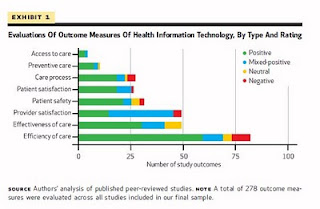

(Click to enlarge.) Evaluations Of Outcome Measures Of Health Information Technology, By Type And Rating
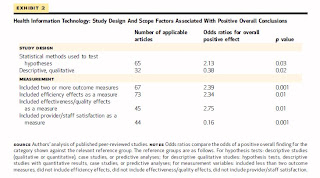


(Click to enlarge.) Health Information Technology: Study Design And Scope Factors Associated With Positive Overall Conclusions

There are several caveats. The first has to do with possible selection bias that can be present in any review article.

On article selection for the review:

... we decided that to be included in this review, an article had to address a relevant aspect of health IT, as listed in the Appendix [7]; examine the use of health information technology in clinical practice; and measure qualitative or quantitative outcomes. Analyses that forecast the effects of a health IT component were included only if they were based on effects experienced during actual use. ... Using this framework, the review team removed 2,692 articles based on their titles. An additional 1,270 articles were determined to be outside the study’s scope after the team examined the article abstracts. For example, 269 abstracts focused solely on health IT adoption.

[What, exactly, does that mean? Were the problems with HIT adoption potentially significant towards causation of lack of benefit, and/or presence of harm, for instance? - ed]

By the third review stage, the review team had 231 articles. An additional forty-three were excluded after further review because they did not meet the criteria, and thirty-four review articles were dropped from the analyses because they did not present new work.

[What does that mean? Did they drop highly comprehensive articles showing uncertainty in the literature about HIT, such as Greenhalgh's "Tensions and Paradoxes in Electronic Patient Record Research: A Systematic Literature Review Using the Meta-narrative Method" from University College London? That article appeared in the Dec. 2009 Milbank Quarterly. I wrote about it at this link.]

This left 154 studies that met our inclusion criteria, 100 of which were conducted in the United States. This is comparable to the 182 studies found over a slightly longer time period that were evaluated by Goldzweig and colleagues.

I should also note that no mention is made of independent reviewers of the article corpus and elimination process. It appears the entire effort was conducted within ONC itself, where a bias towards finding positive results is likely present (and understandable).

Another caveat is the the Health Affairs/ONC article appears to bypass a body of literature, both peer-reviewed and non-peer reviewed, that sheds doubt on health IT in its present form from a number of angles such as I recently aggregated at "An updated reading list on HIT" and at "2009 a pivotal year in healthcare IT." Bypassing literature such as this is a possible major weakness.

Further, in the current political environment, it is not hard to imagine that articles highly critical of health IT, or revealing major mishaps and possibly exposing organizations to litigation, are scarce.

I addressed that in a paper "Remediating an Unintended Consequence of Healthcare IT: A Dearth of Data on Unintended Consequences of Healthcare IT." The paper itself was initially found needing revisions, largely in format, by a small group of blinded reviewers in the Medical Informatics community (with the exception of one faux-newshound who commented that "material like this could be read in any major newspaper", a rather perplexing comment considering the topic). Rather than revise, and not being on the tenure treadmill, I chose instead to publish at the Scribd link above.

The ONC paper does acknowledge this:

A recent study found that for clinical trials, studies with positive results are roughly four times more likely to be published than those without positive findings. Because the articles were limited to health IT adopters, we anticipated that authors more often approached studies looking for benefits rather than adverse effects.

They do, however, then issue a value judgment:

It is important to note that although publication bias may lead to an underestimation of the trade-offs associated with health IT, the benefits found in the published articles are real.

I"m not sure a dear relative of mine would find that value judgment heartening. They suffered a crippling injury that would likely not have occurred if paper had been used in the ED rather than an EHR.

I note that if a pharmaceutical company were to issue such a value judgment about a drug as justification for national marketing, they'd likely be nailed to the cross...

The ONC paper also ignores accounts of "near misses" and actual patient injury from impeccable sources, such as in "Health informatics — Guidance on the management of clinical risk relating to the deployment and use of health software. UK National Health Service, DSCN18 (2009), formerly ISO/TR 29322:2008(E)":

Annex A

Examples of potential harm presented by health software

GP prescribing decision support
In 2004 the four most commonly used primary care systems were subjected to eighteen, potentially serious, realistic scenarios including an aspirin prescription for an eight year old, penicillin for a patient with penicillin allergy and a combined oral contraceptive for a patient with a history of deep vein thrombosis. Using dummy records, all eighteen scenarios failed to produce appropriate alerts by all of the systems, most of the time. The best score was a system that flagged up seven appropriate alerts. The health organization clearly has, in such a system deployment, a key responsibility to ensure that knowledge bases used within a design are correctly populated and aligned with clinical practice within their organization.

Inadvertent accidental prescribing of dangerous drugs (such as methotrexate)
This incident occurred when a user of a primary care system attempted to issue two repeat items. The items were highlighted and instead of the issue selected repeats button, the prescribe acute issues from the formulary button was pressed. This brought up the formulary dialogue which contained the high risk items. Either the issue button was then pressed or the particular items were double clicked. When the warning messages came up, they were all ignored and proceed and issue selected. The user chose the first item presented on the formulary list, which just so happened to be a methotrexate injection. In this particular case, it was determined that patient risk was minimal as the treatment was rarely used in primary care and would, in practice, be rejected by the pharmacist. To preclude any recurrence of the problem, access to the high risk formulary was removed from the formulary part of the acute drug issue dialogue. This example again demonstrates the need to align clinical practice and authority levels with the knowledge and rule bases within the system. Wherever possible, design and implementation of health software systems should be undertaken to improve control and accuracy, note introduce new exposures. Furthermore the hazard and risk assessment of this situation may well not apply in other settings, e.g. prescription issue by nursing staff on a ward versus a pharmacist in a retail store.

Incorrect patient details retrieved from radiology information system
This incident arose from the fact that medical reference numbers (MRNs) are usually prefixed by an alpha code. Some hospitals however do not use these prefixes and identical MRNs can be generated. This gave rise to the creation of shared MRNs and subsequent confusion of records in the central datastore when retrieval key is the Medical Record Number. Four specific instances were found where a patient number had been entered in the radiology information system and incorrect patient details had been retrieved. The manufacturer could have built in an appropriate format check during development. Alternatively, the problem could have been spotted by the health organization if a structured risk assessment had been undertaken.

Drug mapping error
Sodium valproate 200 mg slow release was incorrectly mapped to sodium valproate 200 mg in a formulary encoded into a health software system. These are anti-epilepsy drugs and thus the implications for patient safety could be significant. This particular incident is just one of many that have been reported in relation to drug mapping.

An initial investigation indicated that 35 prescriptions had been generated using the incorrect map. Corrective action included contacting the relevant primary care practices to check upon patient health and the supplier to correct the mapping process to ensure no further incorrect prescriptions were generated. As before, this was a design/coding error by the manufacturer but was compounded by the health organization not checking the mappings and failing either to build in appropriate prescribing controls, or map the controls to health organization individuals with the appropriate experience and authority.

Pre-natal screening
The ages of women who had undergone pre-natal screening were wrongly computed by a health software system. As a result 150 women were wrongly notified that they were at no risk. Of these, four gave birth to Down's syndrome babies and two others made belated decisions to have abortions.

Patient identification
A student died of meningitis because of a misspelling of her name and inadequacy in computer use. The student was admitted and a blood test proved negative for meningitis. The following day another blood test was taken and filed on a new computer entry but the letter ―p was missed in the spelling of the name. When a doctor looked up results they were presented with only the first negative tests result because of the misspelling. If the second result had been seen it would have triggered further investigations and probable diagnosis of meningitis. The investigating panel concluded that problems with the health software system had been greater than first thought and in this case there was a combination of a misspelled name and the doctor not being able to use the computer system property. The health software system could have been designed to use unique numbers either instead of the name or in addition to it.

They also missed consideration of serious IT defects reports as in the FDA's Maude database that I wrote about at my Jan. 2011 post "MAUDE and HIT Risks."

Another confounding factor is the issue of possible unreliability of the medical literature itself as expressed in a recent post on the IBM Watson supercomputer exuberance:

Consider the issue of the medical literature suffering from numerous conflict of interest and dishonesty-related phenomema making it increasingly untrustworthy, as pointed out by Roy Poses in a Dec. 2010 post "The Lancet Emphasizes the Threats to the Academic Medical Mission", at my Aug. 2009 post "Has Ghostwriting Infected The "Experts" With Tainted Knowledge, Creating Vectors for Further Spread and Mutation of the Scientific Knowledge Base?" and elsewhere on this blog.

They do state what I have been writing about for over a decade now:

... In fact, the stronger finding may be that the “human element” is critical to health IT implementation. The association between the assessment of provider satisfaction and negative findings is a strong one. This highlights the importance of strong leadership and staff “buy-in” [which will only occur if the systems are not miserable examples of poor engineering, not due to P.R. or the irrational exuberance of others - ed.] if systems are to successfully manage and see benefit from health information technology. The negative findings also highlight the need for studies that document the challenging aspects of implementing health IT more specifically and how these challenges might be addressed.

Dear ONC: see this site, and the many posts since 2004 on this blog.

I was surprised to see this:

... Taking a cue from the literature on continuous quality improvement, every negative finding can be a treasure if it yields information on how to improve implementation strategies and design better health information technologies.

As in my post at this link, does this mean that 'anecdotal' accounts of HIT problems will no longer be summarily dismissed? I wonder.

I have also written in the past that in order to truly understand a domain, one must look at both evidence of the upside, and evidence of the downside. My concern is that the latter was not well addressed in this paper. A beneficial technology with a significant downside, especially in medicine, is not ready for national rollout (cf. Vioxx).

In summary, the new ONC paper may present a glimmer of hope that health IT is starting to produce real results. On the other hand, its possible deficiencies and biases might also make it more a political statement than anything else. It will certainly be used as such from the high government perch of HHS regardless. This has already started:

... President Obama and Congress envisioned that the HITECH Act would provide benefits in the form of lower costs, better quality of care, and improved patient outcomes. This review of the recent literature on the effects of health information technology is reassuring: It indicates that the expansion of health IT in the health care system is worthwhile.

[Note the use of "is worthwhile" as opposed to "may be worthwhile", a continuation of the "it's proven, nothing else to say" style I noted
at my July 2010 post "Science or Politics? The New England Journal and "The 'Meaningful Use' Regulation for Electronic Health Records." Such statements of absolute certainty are of concern; they remind me of the global warming debate - ed.]

...Thus, with HITECH, providers have an unparalleled opportunity to accelerate their adoption of health information technology and realize benefits for their practices, institutions, patients, and the broader system. [Ditto - ed.]

Does the article truly show a breakthrough, or is it a flawed review by a governmental agency that will be used for political purposes? I simply do not know which.

I am certain, however, that there will be active debate and dissection of this paper and its source articles in the months to come by those with more time, resources, and expertise than I have at my disposal.

-- SS

March 10, 2011 addendum:

Trisha Greenhalgh at Barts and The London School of Medicine and Dentistry and the author of the aforementioned comprehensive review article "Tensions and Paradoxes in Electronic Patient Record Research: A Systematic Literature Review Using the Meta-narrative Method" (link to my essay), had this observation about the following passage in the ONC paper:

“Our findings must be qualified by two important limitations: the question of publication bias, and the fact that we implicitly gave equal weight to all studies regardless of study design or sample size.”

Prof. Greenhalgh relates: "Given these very fundamental acknowledged biases, I’m very surprised anyone published this paper in its present form.”

-- SS

March 14, 2011 addendum:

Dr. Roy Poses had this to say:

Dr Silverstein commented on a new review of research of health care information technology whose results were mainly optimistic. The authors were from the US government agency that promotes health care IT, so its optimism is not surprising. However, its credibility was unclear, since it did not appear to be systematic. [In general, one at least assesses and takes into account the methodologic quality of studies used in a systematic review, and does not "give equal weight to all studies regardless of study design or sample size" - ed.]

Furthermore, the authors had no methodologic standards whatsoever for article inclusion. [They did, sort of, as in my paragraphs "On article selection for the review:", but one might term the standards "loose" - ed.] The review included qualitative studies that were probably not meant to be evaluative, and observational studies subject to severe methodologic bias.

The publication of this review demonstrated how the conventional wisdom is continually reinforced based on the strength of the influence of its proponents, rather than the strength of the supporting evidence. Adaptation of new drugs and devices should be based on evidence that their benefits outweigh their harms, rather than the enthusiasm and financial interests of their proponents.


-- SS

Wednesday, March 2, 2011

Vladimir Putin and Common Sense on IT

Vladimir Putin may be known for showing off his pectorals riding horses bare chested, but he also seems to have a substantial amount of gray matter between the ears.

Our country, including the healthcare IT sector, could probably learn something from him:

A Walled Wide Web for Nervous Autocrats

Wall Street Journal
Jan. 8, 2011

By EVGENY MOROZOV

At the end of 2010, the "open-source" software movement, whose activists tend to be fringe academics and ponytailed computer geeks, found an unusual ally: the Russian government. Vladimir Putin signed a 20-page executive order requiring all public institutions in Russia to replace proprietary software, developed by companies like Microsoft and Adobe, with free open-source alternatives by 2015.

The move will save billions of dollars in licensing fees, but Mr. Putin's motives are not strictly economic. In all likelihood, his real fear is that Russia's growing dependence on proprietary software, especially programs sold by foreign vendors, has immense implications for the country's national security. Free open-source software, by its nature, is unlikely to feature secret back doors that lead directly to Langley, Va.

It's also less likely to feature a backdoor to a hacker's basement, or a lot of bugs ("glitches") that some health IT vendors and customer organizations allow to accumulate into the thousands before lifting a finger.

This brings to mind the adage that "if you want something done right, do it yourself."

... For ordinary Internet users, there is one silver lining: The embrace of open-source technology by governments may result in more intuitive software applications, written by a more diverse set of developers.

[Read the whole article at the link above - ed.]

More intuitive IT applications could solve a lot of the current health IT problems, such as the mission hostile user experience of many closed-source products from major vendors.

Afrer major IT debacles including the £13 billion abyss of the National Programme for IT in the NHS (NPfIT), the UK also seems to be learning:

New approach urged for government IT
E-Health Insider
2 March 2011
Lyn Whitfield

A new report into government IT failures has warned that previous inquiries may have embedded problems by focusing on inappropriate ‘best practice’ instead of looking for alternative approaches.

The report, from the Institute for Government, says “existing ‘best practice’ project models do not deal with the fundamental issues at the heart of government IT.”

[As I've stated here, one has to consider the "worst practices" as well, the "thou shall not's." Typical Milquetoast, touchy-feely "best practices" models and their "sanitized accounts of successful projects" (cf. Greenhalgh et al.) avoid such inconvenient realities like the plague - ed.]

It also argues that: “By implementing these same, flawed project techniques in an increasingly rigid fashion, these traditional solutions can act to exacerbate the problems further.”

[This sounds familiar, typical of the inflexible, dogmatic business IT culture, descended from the punched-card programmable tabulator culture of the 1920's - see this link - ed.]

Instead, it calls for a new that focuses on using government’s huge buying power to get better deals for what it calls ‘platform' technologies – such as server capacity and PCs – while encouraging departments to adopt ‘agile’ methodologies to deliver systems to meet the particular challenges they face.

... Andrew Adonis, Director of the Institute for Government said: “The billions spent on cancelled IT projects, such as ID cards and National Programme for IT in the NHS, demonstrate precisely why we need a much more flexible approach to government IT.

... The report cites the national programme as one ‘symptom of failure’ in government IT; the tendency for projects to run late and for departments to struggle to keep suppliers on board or hold them to their original delivery requirements as a result.


Agile software development methodologies have traditionally been anathema to the culture of IS departments involved in mercantile, manufacturing and management varieties of business computing. As I've written many times, however, those methodologies are essential in healthcare IT, such as here and here. At the latter link I observed:

... In fact, in my observations IT personnel are the true Luddites [as opposed to clinicians who are often accused of that reactionary characteristic- ed.], clinging to inappropriate, rigid business-IT views on the healthcare IT development and implementation process (vs. more appropriate and modern agile methodologies), holding unshakable, stereotypical views about physicians, and remaining unreasonably obstinate on clinician complaints about "clunky" health IT user experiences.

Perhaps Mr. Putin and Mr. Adonis deserve a copy of the book "Medical Informatics 20/20: Quality And Electronic Health Records Through Collaboration, Open Solutions, And Innovation", Jan. 2007, by the VistA (open-source EMR) pioneers.

The "Open Solutions" part of that title says it all.

-- SS

Friday, February 25, 2011

MedInformaticsMD in WSJ again: No Patient Will Ever Say, 'Quick, Watson, the Needle!'

Following along the lines of my Jan. 2011 post IBM's Watson, Jeopardy, and "Revolutionizing Medicine" , the Wall Street Journal published this Letter to the Editor by me today:

Wall Street Journal

LETTERS
FEBRUARY 25, 2011

No Patient Will Ever Say, 'Quick, Watson, the Needle!'

Regarding Ray Kurzweil's "When Computers Beat Humans on Jeopardy" (op-ed, Feb. 17): Librarians often receive requests for information as cryptic as "Jeopardy!" clues, from people who are sometimes not even sure what they're seeking. Watson is, in essence, a librarian that retrieves facts.

Regarding natural language processing and fact-retrieval systems like IBM's Watson, medicine is about cognition. It's about human judgment born of experience in dealing with ambiguity, not just of language but also, and this is critical, of observations, findings, lab data, image interpretation, etc. It is about human intuition, assemblage and the integration of a huge amount of disparate information in ways not well understood even by its practitioners. The end result is not just the recall of a piece of information, obscure as the information might be.

I consider predictions of Watson spearheading cybernetic miracles in medicine to imply just as grandiose a valuation to the technology as the statements I heard two decades ago about the health information technology of the day, or even today, "revolutionizing medicine." That has not happened.

A cybernetic librarian is no physician. As for me, for now I'll stick to people in my own medical care. Let Mr. Kurzweil see the machine for his ailments.

Scot Silverstein, M.D.

Philadelphia


I am pleased that my counter-marketing-hype opinion on the meme of health IT "revolutionizing medicine" was deemed fit to print by the Journal.

Those in senior leadership positions, as are included in the WSJ's readership, need to see that meme challenged.

-- SS

Thursday, February 3, 2011

Brief Comments on the President’s Council of Advisors on Science and Technology (PCAST) Report on Health IT

A short post. In Dec. 2010 the President’s Council of Advisors on Science and Technology issued a 108-page report entitled:

REPORT TO THE PRESIDENT: REALIZING THE FULL POTENTIAL OF HEALTH INFORMATION TECHNOLOGY TO IMPROVE HEALTHCARE FOR AMERICANS: THE PATH FORWARD

The PCAST health IT report is available from whitehouse.gov in PDF format here. Rather than reproduce the executive summary of the report, a terse "PCAST Report Summary" can be seen about midway down the page of the HISTalk blog here. My comments are simple and twofold:

1. The term "risk" is absent from the PCAST report in the context of risk to patients from clinical IT. Instead, the context is largely about the risk to patients of NOT having health IT.

2. The term "safety" is similarly absent in the context of adverse effects of HIT, and only present in the context of how HIT will improve safety, except for one instance where the match to my search for the term "safety" was not in the text, but in the cited URL itself:

... The Food and Drug Administration (FDA), while not currently regulating EHRs, currently does receive voluntary reports of death and injury associated with EHR malfunctions. FDA officials have suggested possible future regulatory strategies that could include mandatory adverse event reporting, or even classifying EHRs as medical devices, which would make them subject to pre-market regulation. [13] [13] Healthcare IT News (February 26, 2010) at http://www.healthcareitnews.com/blog/should-fda-regulate-ehr-safety

I find this paucity of a certain context for these terms in a report to the President of the United States striking. Finally, ONC solicited responses to the PCAST report. The American Medical Informatics Association (AMIA) issued a response that is very good. It outlines practical matters, the need for more Medical Informatics specialists and incorporation of their work into national efforts at a common "language" for medicine, interoperability, and other issues. For instance:

AMIA applauds the PCAST report for addressing important issues regarding interoperability and quality improvement. However, we note that the report highlights potential shortcomings and inadequacies in the current approaches and proposes a number of activities in addition to or instead of those currently underway. AMIA believes that the report would benefit from additional details and specificity to support the recommendations that are proposed. The report does not mention the significant prior work that has been conducted in these areas. Additional consideration of data and lessons learned from the scientific and peer-reviewed literature would help to further support and substantiate the ideas presented.

The AMIA response is available at this link (also PDF). Also see summaries of other responses to the PCAST report at the Jan. 23, 2011 e-CareManagement blog post aptly entitled "Comments to ONC: PCAST HIT Report Becomes a Political Piñata." -- SS

Tuesday, February 1, 2011

An Updated Reading List on Health IT

“It is only the ignorant who despise education.” - Publilius Syrus, Latin Poet, 43-85 AD

In a March 2009 post "A Primer On Why We Have Busywork Generators Masquerading as EMR's: Health IT Reality vs. the Bernard Madoff Version", I posted a "reading list" of articles about health IT that I consider essential in understanding the issues surrounding the experimental nature of this technology.


I wrote:
Anyone contemplating policy work in health IT should be intimately familiar with these works, as they illustrate the true HIT environment in 2009, not the Bernard Madoff "unlimited returns no matter what" version.

What these articles do not illustrate is the common atmosphere of irrational exuberance and complacency now prevalent about HIT, with healthcare organizations and physicians now being pushed forcefully to adopt these technologies or suffer payment penalties they can ill afford:

I've updated the list.

Updated reading list (not meant to be at all comprehensive; this is just a set I've collected over recent years writing on health IT):

-------------------------------------
2012 Addenda:
  • Next-generation phenotyping of electronic health records, George Hripcsak,David J Albers, J Am Med Inform Assoc, doi:10.1136/amiajnl-2012-001145 .  The national adoption of electronic health records (EHR) promises to make an unprecedented amount of data available for clinical research, but the data are complex, inaccurate, and frequently missing, and the record reflects complex processes [economic, social, political etc. that bias the data - ed.] aside from the patient's physiological state. .
  • Comparative user experiences of health IT products: How user experiences would be reported and used. Discussion Paper, Institute of Medicine, Washington, DC. Sinsky, C. A., J. Hess, B-T. Karsh, J. P. Keller, and R. Koppel, 2012.  At present, some [most if not all - ed.] vendors prohibit users from sharing screenshots and otherwise effectively communicating with others about a problem with an EHR. There is currently no place for health IT users to share publicly the experiences they have had with their health IT products. 

  • Patient Safety Problems Associated with Heathcare Information Technology: an Analysis of Adverse Events Reported to the US Food and Drug Administration. Magrabi, Ong, Runciman, Coiera, Australia.  AMIA Annual Symposium Proceedings 2011; 2011: 853–857. 2011.  Healthcare information technology (HIT) events associated with patient harm recognized as such, and voluntarily submitted to the FDA Manufacturer and User Facility Device Experience (MAUDE) database, were analyzed. The authors examined the problems in 46 relevant events submitted to MAUDE from January 2008 to July 2010 to identify natural categories of problems from a clinical perspective. CPOE and PACS were found to be involved in 93% of the events. Adverse events were associated with medications in 41%, clinical processes in 33%, radiation in 15% and surgery in 11%. There were four deaths.

-------------------------------
Late 2011 Addenda
  • Health IT and Patient Safety: Building Safer Systems for Better Care, U.S. Institute of Medicine (IOM) of the National Academies, Nov. 2011. The IOM is aware of severe health IT risks and safety issues, recognizes that health IT is unregulated, but admits it does not know the magnitude of the risks and safety issues. (Is that the proper environment for rapid national deployment?)
-------------------------------

[1] Electronic Health Records and Clinical Decision Support Systems: Impact on National Ambulatory Care Quality. Max J. Romano, BA; Randall S. Stafford, MD, PhD, Arch Intern Med. Published online Jan. 24, 2011. doi:10.1001/ archinternmed.2010.527. Conclusion: "Our findings indicate no consistent association between EHRs and CDS and better quality. These results raise concerns about the ability of health information technology to fundamentally alter outpatient care quality." 

[2] Electronic Health Record Use and the Quality of Ambulatory Care in the United States. Linder, Ma, Bates et al. Arch Intern Med. 2007;167:1400-1405. Conclusion: As implemented, EHRs were not associated with better quality ambulatory care.

[3] The Impact of eHealth on the Quality and Safety of Health Care: A Systematic Overview. Black AD, Car J, Pagliari C, Anandan C, Cresswell K, et al. PLoS Medicine 8(1): e1000387 (Jan. 18, 2011). doi:10.1371/journal.pmed.1000387. Conclusion: There is a large gap between the postulated and empirically demonstrated benefits of eHealth technologies. In addition, there is a lack of robust research on the risks of implementing these technologies and their cost-effectiveness has yet to be demonstrated, despite being frequently promoted by policymakers and “techno-enthusiasts” as if this was a given.

[4] Electronic Health Records’ Limited Successes Suggest More Targeted Uses. DesRoches, Jha et al., Health Affairs, April 2010 vol. 29 no. 4 639-646, doi:10.1377/hlthaff.2009.1086. Abstract: We examined electronic health record adoption in U.S. hospitals and the relationship to quality and efficiency. Across a large number of metrics examined, the relationships were modest at best and generally lacked statistical or clinical significance.

[5] Health information technology: fallacies and sober realities. Karsh et al. (Oct. 2010). JAMIA 2010 17: 617-623. Abstract: We discuss 12 HIT fallacies and their implications for design and implementation. These fallacies must be understood and addressed for HIT to yield better results. Foundational cognitive and human factors engineering research and development are essential to better inform HIT development, deployment, and use.

[7] The Top Ten Health Technology Threats to Patient Safety for 2011. ECRI Institute, Plymouth Meeting, PA, Dec. 7, 2010. Data loss, system incompatibilities, and other health IT complications is #5.

[8] Current Approaches to U.S. Healthcare Information Technology are Insufficient. Computational Technology for Effective Health Care: Immediate Steps and Strategic Directions. National Research Council of the U.S. National Academies, Jan. 2009. Abstract: Current efforts aimed at the nationwide deployment of health care information technology (IT) will not be sufficient to achieve medical leaders' vision of health care in the 21st century and may even set back the cause, says a new report from the National Research Council ... The report describes difficulties with data sharing and integration, deployment of new IT capabilities, and large-scale data management. Most importantly, current health care IT systems offer little cognitive support; clinicians spend a great deal of time sifting through large amounts of raw data (such as lab and other test results) and integrating it with their medical knowledge to form a whole picture of the patient.

[9] Evaluating the Impact of the Electronic Health Record on Patient Flow in a Pediatric Emergency Department. Mathison, Chamberlain, Children's National Medical Center – Division of Emergency Medicine, Washington, DC. Applied Clinical Informatics, Vol. 2, Issue 1, 2011, 10.4338/ACI-2010-08-RA-0046

[10] A Critical Essay on the Deployment of an ED Clinical Information System ‐ Systemic Failure or Bad Luck?, Professor Jon Patrick, Health Information Technology Research Laboratory, School of Information Technologies, University of Sydney, Australia, Jan. 2010. Severe software engineering flaws in a major U.S. EHR for emergency rooms makes the software difficult to use, unstable and subject to unpredictable data loss.

[11] E-Health Hazards: Provider Liability and Electronic Health Record Systems. Sharona Hoffman and Andy Podgurski. Berkeley Technology Law Journal (2010). Followup paper on EHR medical and legal risks. This article is a first of its kind, a comprehensive analysis of the liability risks associated with use of clinical IT. The authors point out that the potential benefits of computerization could be substantial, but EHR systems also give rise to new liability risks for health care providers that have received little attention in the legal literature. 

[12] Meaningful Use and Certification of Health Information Technology: What About Safety? Sharona Hoffman and Andy Podgurski. Case Research Paper Series in Legal Studies Working Paper 2010-34, October 2010.

[13] Finding a Cure: The Case for Regulation And Oversight of Electronic Health Records Systems, Sharona Hoffman and Andy Podgurski. Harvard Journal of Law & Technology 2008 vol. 22, No. 1

[14] Emerging Trends in Electronic Health Record Liability. Chad P. Brouillard. For the Defense, July 2010 (Defense Research Institute).

[15] Electronic Health Records: Recognizing and Managing the Risks. ClaimsRx: Clinical and Risk Management Perspectives. NORCAL Mutual Insurance Company, Oct. 2009.

[16] Litigation in the Decade of Electronic Health Records. Joel B. Korin and Madelyn S. Quattrone. New Jersey Law Journal, June 11, 2007.

[17] Role of Computerized Physician Order Entry Systems in Facilitating Medication Errors. Ross Koppel, PhD, et al, Journal of the American Medical Association, 2005;293:1197-1203

[19] Hiding in Plain SIght: What Koppel et al. tell us about healthcare IT. Christopher Nemeth, Richard Cook. Journal of Biomedical Informatics. 38 (4): 262-3.

[20] Health Care Information Technology Vendors' "Hold Harmless" Clause - Implications for Patients and Clinicians, Ross Koppel and David Kreda, Journal of the American Medical Association, 2009; 301(12):1276-1278

[21] Hospital Computing and the Costs and Quality of Care: A National Study. Himmelstein. Wright, Woolhandler. The American Journal of Medicine, Volume 123, Issue 1 , Pages 40-46, January 2010.

[22] Unintended errors with EHR-based result management: a case series. Yackel and Embi; JAMIA 2010 17: 104-107; doi: 10.1197/jamia.M3294, Oct. 2009.

[23] Information Technology: Not a Cure for the High Cost of Health Care: Knowledge@Wharton, Wharton School of Business, University of Pennsylvania, June 10, 2009. (PDF version available at this link).

[24] Contemporary Issues in Medical Informatics: Common Examples of Healthcare Information Technology Difficulties. Teaching website, Scot Silverstein, MD, Drexel University, College of Information Science and Technology, Philadelphia, PA. Site initiated in 1999.

[25] Healthcare Renewal blog. I write on healthcare IT issues at this multi-author website sponsored by the Foundation for Integrity and Responsibility in Medicine (FIRM), a 501(c)(3) advocacy group. FIRM researches problems with leadership and governance in healthcare that threaten healthcare's core values.

[26] Health IT Project Success and Failure: Recommendations from Literature and an AMIA Workshop. Journal of the American Medical Informatics Association. Bonnie Kaplan and Kimberly D. Harris-Salamone. 

[27] Joint Commission: Sentinel Events Alert on HIT, Dec. 2008.

[28] Internal FDA memorandum on HIT risks to Jeffrey Shuren MD JD (Director, Center for Devices and Radiological Health). "Not Intended for Public Use." Feb. 23, 2010. (Description/summary of memorandum is at this link).

[29] FDA's Manufacturer and User Facility Device Experience database (MAUDE) and HIT risks. Healthcare Renewal Blog, Scot M. Silverstein MD, Drexel University, Philadelphia, PA, Jan. 2011

[30] Health IT's Mission Hostile User Experience (eight-part essay), Healthcare Renewal Blog, Scot M. Silverstein MD, Drexel University, Philadelphia, PA, Feb. - Mar. 2009.

[31] The National Programme for IT in the NHS: Progress since 2006. Summary points, conclusions & recommendations. UK Parliament House of Commons, Public Accounts Committee, January 2009. (Full report at this link.)

[32] The future of the NPfIT. Program slated for major downsizing and decentralization after poor progress and expenditures exceeding £13 billion. UK Dept. of Health, Sept. 2010.

[33] "Don't Repeat the UK's Electronic Health Records Failure". Stephen B. Soumerai, Professor of Population Medicine at Harvard Medical School, Anthony Avery, Professor of Primary Care at the University of Nottingham Medical School, UK. Huffington Post, Dec. 5, 2010.

[34] Health informatics — Guidance on the management of clinical risk relating to the deployment and use of health software. UK National Health Service, DSCN18 (2009), formerly ISO/TR 29322:2008(E).

[35] Health Informatics — Application of clinical risk management to the manufacture of health software. UK National Health Service, DSCN14 (2009), formerly ISO/TS 29321:2008(E).

[37] Medical Project Agency's Working Group on Medical Information Systems: Project summary. Proposal for guidelines regarding classification of software based information systems used in health care. Läkemedelsverket - Swedish Medical Products Agency (MPA), June 2009, revised Jan. 2010.

[38] Tensions and Paradoxes in Electronic Patient Record Research: A Systematic Literature Review Using the Meta-narrative Method. Greenhalgh, Potts, Wong, Bark and Swinglehurst, University College London. Milbank Quarterly, Dec. 2009. 


[41] Software hiccups cause drug, treatment errors at VA”, Associated Press, January 14, 2009

[42] Electronic Records System Unreliable, Difficult to Use, Service Officials Tell Congress, Sandra Basu, U.S. Medicine - the Voice of Federal Medicine, May 2009

[43] Unexpected Increased Mortality After Implementation of a Commercially Sold Computerized Physician Order Entry System, Han et al., PEDIATRICS Vol. 116 No. 6 December 2005, pp. 1506-1512 (doi:10.1542/peds.2005-1287).

[44] The Computer Will See You Now, New York Times, Armstrong-Coben, March 5, 2009.

[45] Physician testimony to HHS Standards Committee Implementation Workgroup of the ONC, Jan. 11, 2011. Reproduced with permission at Healthcare Renewal blog.

[46] Bad Health Informatics Can Kill. Working Group for Assessment of Health Information Systems of the European Federation for Medical Informatics (EFMI).

[48] "The failure rates of EMR implementations are also consistently high at close to 50%", from Proceedings of the 11th International Symposium on Health Information Management Research – iSHIMR 2006 

[49] Adverse Effects of Information Technology in Healthcare. This knowledge center presents a collection of information on the adverse effects of information technology in its application to healthcare. It also references sources of information on information security, and related media reports.

[52] Pessimism, Computer Failure, and Information Systems Development in the Public Sector. Shaun Goldfinch, University of Otago, New Zealand, Public Administration Review 67;5:917-929, Sept/Oct. 2007

-- SS